 [Carl Chiarenza (September 1935-May 3, 2026) died in Rochester, NY, his birthplace, on May 3, 2026. He was 90 years old.
For his obituary at the website of the University of Rochester, where he taught for decades, click here. For a 2019 interview with him by Charles Giuliano, click here. For the website dedicated to his work: https://www.carlchiarenza.com/. You can also download a PDF of his germinal essay “Notes Toward An Integrated History of Picturemaking,” courtesy of the George Eastman Museum.
In 2009 Carl contributed a Guest Post to this blog, “The Centrality of Polaroid 55 Film to My Practice.”
The following essay had its inception as the commissioned text for an illustrated brochure accompanying the exhibition “Carl Chiarenza: Photographs 1984-1997,” in the Folk Art and Photography Galleries, High Museum of Art, Atlanta, GA. November 15, 1997-February 14, 1998. For that publication it bore the title “Carl Chiarenza: Pushing the Envelope.”
An extract from it, along with a portfolio of his images, appeared as “Carl Chiarenza: Tears and Pressures” in The Photo Review, vol. 21, no. 1, December 1998. Under the same title, this full version appeared in the British journal Ag: Darkroom Practice & Photography, no. 25, September 2001. — A.D.C.]
•
Carl Chiarenza: Tears and Pressures
It’s commonplace and convenient to date the introduction of the concept of the photograph as metaphor to Alfred Stieglitz’s creation, beginning in 1923, of the series of cloudscapes he called “equivalents.” In fact, this idea had some precursors, and Stieglitz was certainly not its only exponent at that moment. Christian Schad, Man Ray and Laszlo Moholy-Nagy were already exploring the photogram; Alvin Langdon Coburn had made his first “vortographs” through a kaleidoscopic lens; Paul Strand and Edward Steichen had zoomed in macrocosmically on fragments of the natural world.
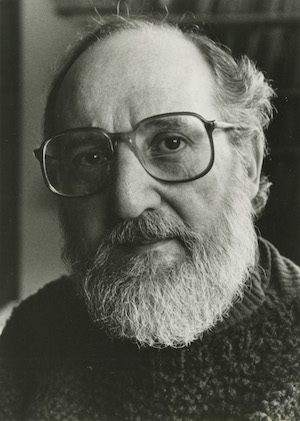
Carl Chiarenza. Photo by Heidi Katz.
The important point for which we use Stieglitz’s project, with its accompanying manifesto, as useful reference point is this: three-quarters of a century ago, some photographers began actively arguing for and exemplifying in their work the proposition that a photograph was not necessarily about what it was of. The photograph, they insisted, was not transcriptive but descriptive, thus interpretive, and could convey poetic as well as semantic meaning.[1]
This declaration sparked a complex international debate that raged for the next fifty years and, though resolved for many, has still not been laid entirely to rest.[2] To summarize this multi-faceted argument, let’s say that those of this tendency insisted that photography as a medium of creative expression was not merely recordative, nor necessarily subject-dominated, but in certain usages was viable for the concerns of the poet and accessible to the mark of the mind.[3] Much of that discourse centers around the concept of abstraction in photography or, as it’s sometimes put, “subjectless” photography, problematic notions at best — as the work of Carl Chiarenza so lucidly demonstrates.
•
The creative photographers of Carl Chiarenza’s generation found themselves confronted by a set of tasks that, if not Herculean, must surely have seemed monumental. Their medium lacked anything beyond a rudimentary written history, had only a spotty theoretical lineage and could boast not much more as a critical tradition, manifested little in the way of a formalized pedagogy, enjoyed no academic status in the realm of higher education and no widespread function in the lower grades, owned a laughable track record as gallery-sponsored art and a somewhat more substantial but also more incoherent one as a museumized medium, benefited from no accepted curatorial practice and no standardized or tested methods for preservation and conservation, was in constant danger of the loss of key masterworks through physical neglect and casual discarding, and, aside from its applied modes, was not considered “fit work for a grown man.”
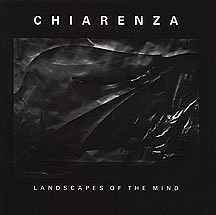
Carl Chiarenza, Landscapes of the Mind (1988), cover
To their credit, more than a few of these men and women took all that as a challenge not only to pursue their own picture-making in the face of this disregard and deprecation but also to change the context in which they and their colleagues worked. Entering the medium at a time when it was still approximately possible to know almost everything then known about it, they took on one or more of these ancillary tasks with gusto and helped to move things forward in various ways. The transformation of the medium over the past forty years constitutes an achievement for which they have yet to receive the credit due them, individually and collectively.[4]
Carl Chiarenza is one of these transformational figures, and one who has done many things — not only done them well, but done them in exemplary fashion. Indeed, Chiarenza is one of the medium’s Renaissance men: artist, critic, historian, theorist, educator. In all of those roles, he has since the late 1950s not only lived through but participated actively in the contest over the meaning, function and status of photographs as communicative and creative artifacts. While he chooses to present his photographs to us as autonomous if interrelated works of art, unburdened by elaborate theoretical trappings, they are at once acts of theory as well as of praxis.
But this is not work that I would call theory-driven; Chiarenza comes from a cohort which understood that theory informs praxis while praxis tests theory. Imbued with all of his concerns, including the hermeneutical discourse around photography, his images offer provocation and reward to any attentive viewer while giving up their deepest and most resonant implications to those who keep this historical context in mind.
Another photographer of Chiarenza’s generation, Walter Chappell, proposed long ago[5] that photography consisted of two components: what he called “camera vision” — the ability to freeze a moment in the visual flux and anticipate how that static extract would look — and “the printmaker’s craft,” the translation of that extract into physical form. In Chiarenza’s work we can see a delicate, precise balance struck and maintained between those two aspects of photography as a poetic enterprise.
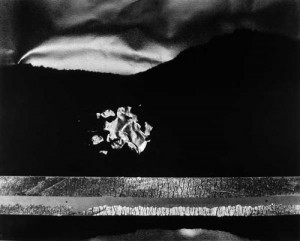
Carl Chiarenza, “Noumenon 016,” 1984
The literal subject matter of Chiarenza’s work is scrap paper and other detritus, arranged into small, comparatively flat or two-dimensional configurations we might call collages or assemblages. These organizations of this raw material in the photographer’s studio are, as some say, “fabricated to be photographed,” meaning that they have no independent life as artworks; their components are dispersed after the photographs of them are made.
So the photographs do in fact operate on one level as records of particular if temporary conjunctions of physical objects, rendered in sharp focus and registered through the lens on large-format negatives that yield highly detailed prints, encoding enough specific data that when we scrutinize them we can often tell what they are pictures of: ripped strips of envelope, bits of gift wrap, lids of cans and such, nothing inherently important, mere stuff. But that does not make them either “subjectless” or abstract; indeed, Chiarenza seems insistent on allowing his raw materials to remain identifiable. Their physicality — wrinkles and folds, torn edges and heat blisters — remains visible, makes the experience of engaging with these representations of them a highly tactile, sensory experience.
At the same time, Chiarenza organizes this stuff into arrangements that, lit and photographed in certain ways, yield negatives which, when interpreted in the darkroom according to thoughtful strategies and scaled extremely large, produce engulfing photographic prints. And these images, though nominally two-dimensional, suggest other things, sometimes beings but more often scapes — deep, complex, convoluted spaces through which the viewer’s eye seeks to wander, drawn almost irresistibly into the intricate folds of this purely illusory terrain. And this, too, is a sensual, haptic experience, in which we seem to make our way as much by touch as with the sense of sight.
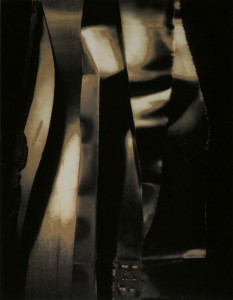
Carl Chiarenza, “Untitled 188a,” 1990-2000
In the work of many of his predecessors and co-workers in this mode — I’m thinking here, just for example, of Henry Holmes Smith and Minor White — I’d be inclined to call those figures and scapes the work’s content, its subject (as distinct from its subject matter), what it is about rather than of. But, if you’ll forgive the pun, these images push the envelope of this form a step further. Smith, White and others asked their viewers to forget, or at least set aside, their awareness of the literal subject matter in order to concentrate on the metaphorical.
Chiarenza, instead, asks us to remember it — to keep in mind what we’re looking at, that tangible yet negligible stuff — while at the same time following the impulse to project ourselves into the imaginary spaces the work implies, without losing sight of the fact that the symbol system enabling that perceptual and philosophical challenge is photographic representation. His respect for our intelligence is such that he believes us capable of holding these three ideas simultaneously and relishing the exciting, unsettling tensions, contradictions and resonances between them.
So, at the risk of oversimplifying an extremely complex proposition, these pictures are about the fact that photography allows you to make images of things that — by the thoughtful application of techniques and perceptual tendencies peculiar to photography — can suggest something quite different from what lay before the lens, can be about something else entirely. Encountering these images, therefore, becomes — if we give ourselves the time and full attention they require to do their work on us — an important lesson in seeing: not just in how this photographer himself sees, but how we all see.
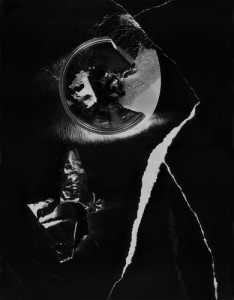
Carl Chiarenza, “Untitled 108,” 2002
It is a lesson no less urgent because it comes to us in the form of play, a prestidigitator’s tour de force in which the magician first allows us to trick ourselves, then lays the cards on the table to teach us the trick, and finally leads us to contemplate the structures of our own credulity. And it is a lesson embedded in works that are fundamentally and necessarily visual, that absolutely require the specific medium in which they’re cast and the craft strategies by which they’ve been made — and that call insistently to the eye and mind and ravish the sensorium.
That’s the act of a true teaching artist — a term that has fallen into some disrepute in our era of academicized artmaking, faculty careerism and tenure-track sinecures. Chiarenza’s project here, which stands on its own but also needs to be understood as a central component in a much larger life-long enterprise, goes a long way toward restoring the dignity and gravity once attached to that term. I know of no body of work that better exemplifies that combination of the educational and creative impulses. In it, among many other things, one can find recognizable traces of and references to previous efforts along these lines by the photographers already mentioned and others — many of them distinguished educators themselves.[6] As does every fine teacher, Chiarenza has distilled for us the core understandings from his discipline’s past. And, as every serious artist must, he has carried that set of ideas a long step forward.
•
Notes:
[1] Kenneth Burke, “Semantic and Poetic Meaning,” in The Philosophy of Literary Form: Studies in Symbolic Action (New York: Vintage Books, 1957), pp. 121-44.
[2] Semiotic analysis of photographs, for example, largely disregards the medium’s poetics, and in extreme cases denies the very existence thereof.
[3] Burke’s Marxian argument is a much more subtle and nuanced one than that of those who claim that, in effect, the idea of a photographic poetics is invalid, and who see in this development something derisively dismissed as “the invention of photographic meaning.”
[4] One can only marvel at the ahistorical state of contemporary theory and criticism of photography when reading, for example, an essay like James Crump’s recent “Visions the Eye Can’t See,”Art in America, Vol. 85, no. 3 (March 1997), pp. 61-63, about a late 1996 exhibit in San Francisco of work by four British photographers — Christopher Bucklow, Susan Derges, Garry Fabian and Adam Fuss — who “remain attached to ambiguous or inexplicable forms that suggest the medium’s metaphysical and expressive potentials. … [E]ach would contend that work which blurs the distinctions between art and science, between realism and abstraction, has for too long been ignored.” This exhibit, at Fraenkel Gallery in San Francisco, was titled “Under the Sun.”
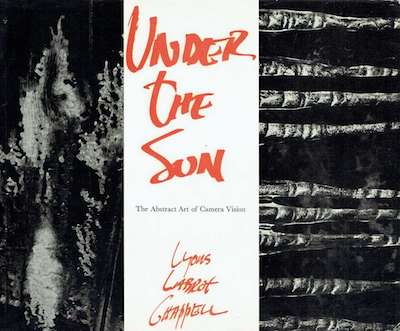
Lyons, Labrot, Chappell, Under the Sun (1972), cover
It appears that none of those involved, including the critic, had ever heard of the Association of Heliographers, the 1960s movement with which Chiarenza and numerous others were involved, nor encountered the 1960 monograph published by three of them — Nathan Lyons, Syl Labrot, and Walter Chappell — titled Under the Sun: The Abstract Art of Camera Vision (Honeoye Falls, NY: Glyph Press, 1960; reprint edition Millerton, NY: Aperture, 1972). For more on the subject of the Heliographers, see my essay, “‘For what else they might be’: The Association of Heliographers, 1963-1966,” Photo Techniques, Vol. 20, no. 5 (September-October 1999), pp. 33-37.
[5] In “Comment: Walter Chappell,” in Under the Sun, unpaginated.
[6] I think here, of course, of Aaron Siskind; Chiarenza’s brilliant 1982 study of him, Aaron Siskind: Pleasures and Terrors (Boston: New York Graphic Society/Little, Brown, 1982) — one of the few true critical biographies ever produced on a photographer and his work — remains a model for the field. But others also come to mind; Chiarenza’s imagery folds in, reconsiders and extends ideas and strategies not only from Stieglitz, Siskind, White and H. H. Smith, but from Frederick Sommer, Jaromir Stephany, Carlotta Corpron, and Lotte Jacobi, to name a few.
•
This post sponsored by a donation from Carlyle T.
•
Special offer: If you want me to either continue pursuing a particular subject or give you a break and (for one post) write on a topic — my choice — other than the current main story, make a donation of $50 via the PayPal widget below, indicating your preference in a note accompanying your donation. I’ll credit you as that new post’s sponsor, and link to a website of your choosing.
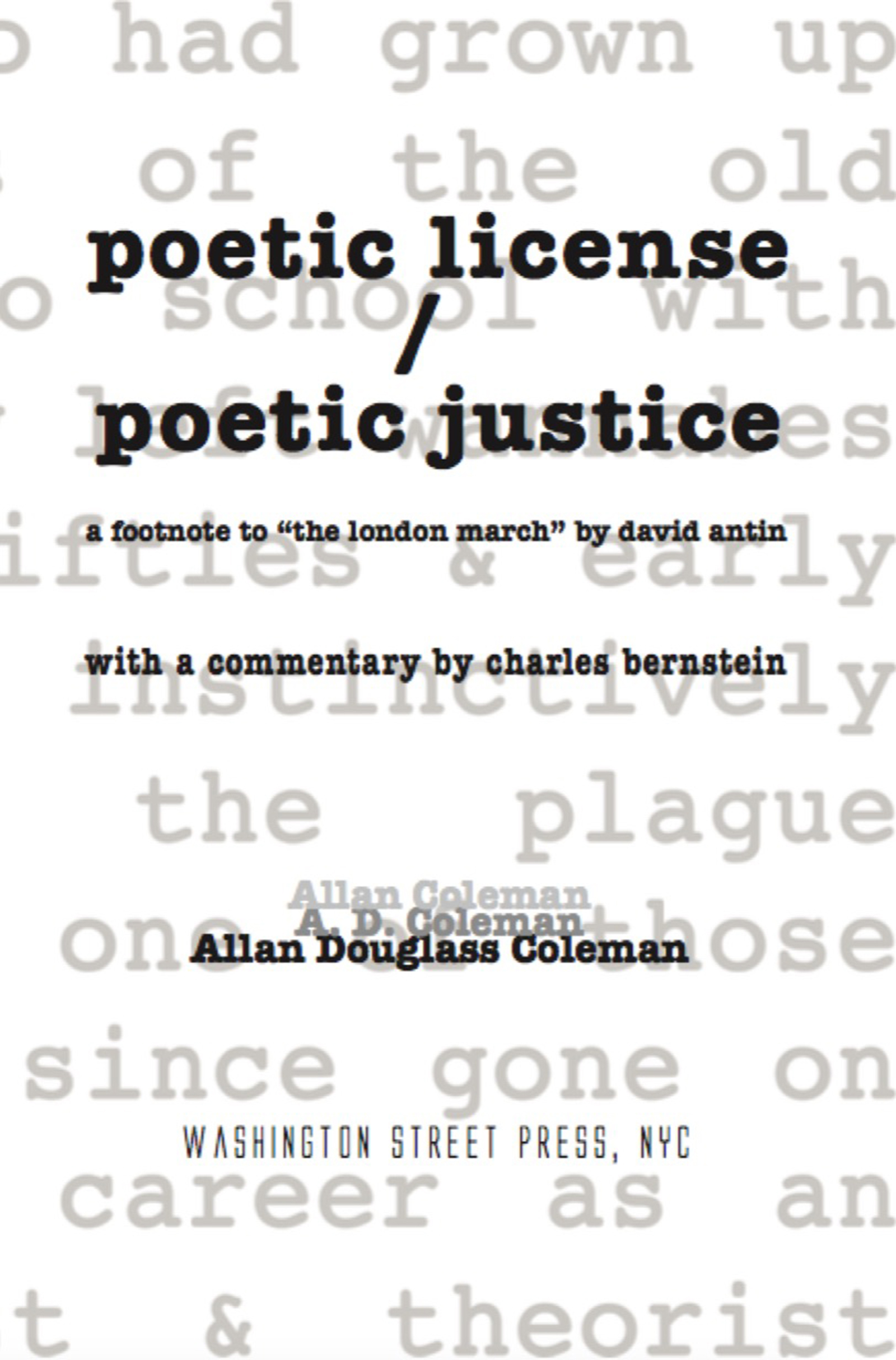
And, as a bonus, I’ll send you a signed copy of my new book, poetic license / poetic justice — published under my full name, Allan Douglass Coleman, which I use for my creative writing.
[donateplus]