
As I noted in my last post, the internet paid little serious attention to this 82nd anniversary of D-Day. Searches for Robert Capa D-Day 2026, conducted in both Google and DuckDuckGo, turned up few substantial posts actually timed to commemorate the occasion.
Continuing my roundup of D-Day anniversary-related Capa material online: The most useful contribution I found to the literature on Capa’s D-Day work came in an unexpected form — “D‑day’s secret weapon: How wetland science stopped Normandy landings from getting bogged down,” by Christian Dunn, published at The Conversation on June 5, 2026. (This site’s motto: “Academic rigor, journalistic flair.”)
I’d never considered the issue Dunn highlights in this article, which begins thus:
Beneath the roar of gunfire and the chaos of D-day, an unlikely hero played a vital role — wetland science. Often overlooked amid military strategies and troop movements, the study of mud proved critical to the success of the largest amphibious invasion in history.
In an engaging, remarkably lucid, and blessedly non-jargonized essay, Dunn — Professor in Natural Sciences, Bangor University, Glasgow, UK — gets literally into the weeds as he explains how the Allies researched the Normandy coast so as to better understand the (literal) ground conditions there and how those would affect the landing. Definitely worth reading, as an example of the attention to detail that went into the planning of this epic military mission and how to elucidate such matters for the general public.
•
The same searches did turn up (a) a surge of AI slop, addressed in my previous post, and (b) some relevant material that has come online (or come to the attention of search-engine web crawlers) since I made my last sweep a year ago. Herewith a few samples.
•
No telling where the Capa D-Day myth will pop up, whose byline it will appear under, or whose platform will further viralize it. It has long since become self-propagating. Case in point: “Robert Capa: D-Day,” which originally appeared as “Le Flou d’un Temps où les Choses Étaient Nettes,” Reporters Without Borders, no. 50. 2015, special issue: Robert Capa: 100 Photos for Press Freedom, p. 100. (Machine translation of the title: “The Blur of a Time When Things Were Clear.” You can download a PDF of the English-language version here.)
This consists of a short meditation on Capa’s D-Day images by Julian Stallabrass, self-described at his website as
a writer, photographer, curator and lecturer, with a particular interest in the relations between art and politics. I have researched modern and contemporary art, especially the globalisation of art and the biennial scene, the history of photography and new media, images of war, and the relations between cultural and political populism.
In his text Stallabrass waxes poetic:
Capa ironically called his autobiography Slightly Out of Focus, his lack of technical perfection being caused by the pressures of working up close to fast-moving subjects, often in battle. The D-Day pictures are famously blurrier than most — and not only because of the intensity of enemy fire on Omaha Beach but because of exposure errors and (it has long been claimed) a darkroom drying accident that destroyed most of Capa’s negatives, and gave the few that survived an extraordinary surface of jagged fluidity which seemed to express the tensions in the event between panic and advance, steel and sea.
The shine from all that poetic wax can’t hide the fact that a bit of research would have informed Stallabrass that the “darkroom drying accident” has been seriously challenged and Capa’s D-Day negatives show no sign of either “exposure errors” or processing damage.
•
The exhibition “Robert Capa. Photographe de Guerre” (“Robert Capa: War Photographer”) opened on February 18, 2026, at the new Musée de la Libération de Paris. Co-curated by Sylvie Zaidman, the museum’s director, and Michel Lefebvre, author of several books on Capa, this retrospective show will run until December 20 of this year. Here’s the museum’s English-language description of the project.
 Given the museum’s mission to commemorate the years during which the German invaders took over the City of Lights, this show logically pays particular attention to the days when Capa covered the Allied forces freeing the French capital from Nazi occupation, August 25-26, 1944. That led to some serious research, with significant results.
In a review of the show, “‘He invented a style’: war chronicler Robert Capa refashioned himself and revolutionised photography” (The Guardian, February 18, 2026), Jon Henley writes,
… as part of its new retrospective, the Museum of the Liberation of Paris has produced a short but remarkable candid film of Robert Capa on the job. He is largely unaware he is being filmed and the cameramen mostly do not know they are filming him. …
… the exhibition’s 15-minutes film reveals his loping form, digitally highlighted, haring towards the heart of the action; taking cover as shots get too close; jumping on to a Free French scout car; mixing with the half-fearful, half-jubilant crowd.
On just one occasion he slips out of role. After a fierce exchange of fire between German troops and the Free French fighters in the rue de Bourgogne, Capa followed the victors to the Palais Bourbon, home of the French parliament.
There, US film footage clearly shows him first photographing a uniformed Nazi officer, clutching a white cloth, approaching and speaking to the German soldiers still inside — then setting his camera aside and helping talk them into surrender.
To assemble this compilation they worked — courtesy of Magnum Photos — from Capa’s contact sheets from those days, some 500 images, using them to establish Capa’s movements through the city, and then correlating those with U.S. Signal Corps film footage from the same locations.
I look forward to seeing it. Unfortunately, this montage of clips from U.S. Army films does not appear to have made it online yet. You can catch a few tantalizing glimpses of it in this interview with Vincent Bray, who supervised the detective work that unearthed this archival material. If I find it online, I’ll link to it in a future post.
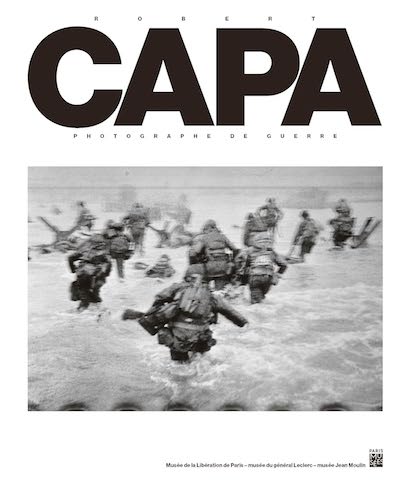
Robert Capa: Photographe de Guerre (2026), cover
About Capa’s D-Day images Henley says this: “The 11 out-of-focus shots he grabbed from the slaughter of Omaha beach on D-day are terrifying.” That is almost entirely wrong. There are only 10 Easy Red exposures. None of them show anything remotely resembling “slaughter.” None of them show anything “terrifying.” Notably, however, Henley doesn’t repeat the myth about “lost” and/or “ruined” negatives. So I’ll count this as a draw.
(Something about the mythologized Capa induces normally sensible people to stop using their eyes to actually see what’s in his pictures and describe that straightforwardly. Instead, they see the myth, press the hyperbole button, and away we go. Henley also writes, “Despite controversy over its location and the identity of its subject, The Falling Soldier remains one of the most astonishing war photographs of all time.” That is, until you learn that it was staged, at which point it becomes mediocre. Henley indicates that he’s aware of J. M. Susperregui’s research proving that — but chooses to disregard it in order to retain his “astonishment.”)
I don’t yet have access to the catalog for this latest Capa exhibition, so I can’t tell how (or if) co-curators Zaidman and Lefebvre addressed our research on his D-Day photographs. I’ll keep my expectations modest, because, in the case of Lefebvre, I suspect we’ll find ourselves playing …
•
Capa D-Day Whack-a-Mole
As any revisionist historian, researcher, or journalist will confirm, extracting a myth from the culture in which it’s become deeply embedded resembles nothing so much as the game Whack-a-Mole. Moreover, once it goes viral its various parts replicate independently, as a result of which you can never extricate them all.
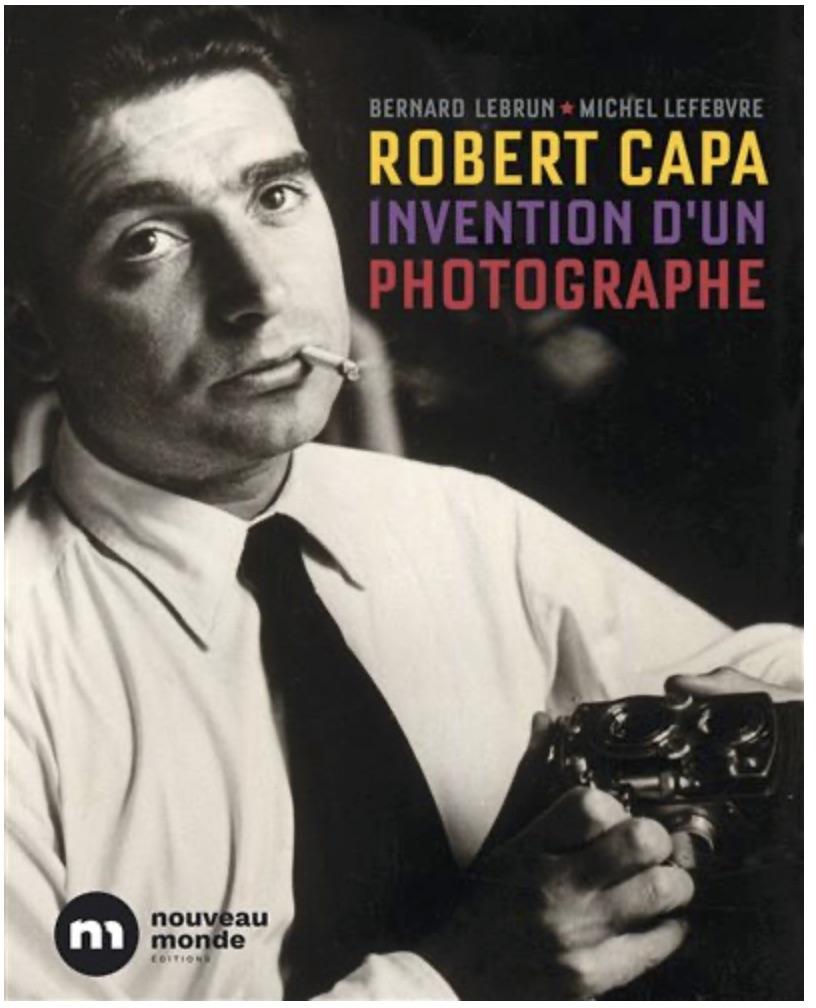
Robert Capa, invention d’un photographe, Bernard Lebrun & Michel Lefebvre (2025), cover
Case in point: Robert Capa, invention d’un photographe, by Bernard Lebrun and Michel Lefebvre (Paris: Nouveau Monde Éditions, 2025). The book’s title translates as Robert Capa: Invention of a Photographer. It’s a revised and expanded edition of an earlier Capa biography by the same authors, Robert Capa: Traces d’une légende (Paris: Editions de la Martinière, 2011). In between the two editions, Lebrun and Lefebvre published the French and English editions of Robert Capa: The Paris Years 1933-54 (New York: Harry N. Abrams, 2012). Lebrun died in 2021, which means that responsibility for updating the 2011 biography fell mainly to Lefebvre.
•
Our investigation of the Capa D-Day myth had not begun when the Lebrun-Lefebvre biography first came out, so that volume simply parroted the standard story. Clearly, and appropriately, the author(s) felt obligated to address our findings in this new version, which they do in a section titled “Landing at Omaha Beach.” While it’s not disrespectful of our research, it’s strewn with so many errors that it’s really embarrassing for the authors. Here’s a machine translation of the original French text. The relevant portions appear indented, in italics, with my corrective notes following:
The Americans call them the Magnificent Eleven. Eleven photographs unique in the world, taken by Robert Capa on Omaha “Bloody” Beach on June 6, 1944. These eleven negatives are said to have been saved from among four rolls containing 106 photos that Capa sent to London from the port of Portsmouth and that were destroyed during development. This darkroom accident was often recounted in great detail by John Morris, then picture editor of Life’s British bureau. …
There were only ten Capa negatives depicting events on Easy Red, never eleven.
Dennis Banks, a young lab technician, is said to have closed the door of the film dryer; the electric heater of the cabinet would have melted the film. This thesis long prevailed. …
No film dryer ever used in any professional darkroom “would” melt the negatives if its doors were closed. Film dryers and film-drying cabinets are designed for use with their doors closed. Indeed, there’s no other reason to use one.
An American journalist, A. D. Coleman, after many investigations, defends another version. According to him, Capa landed with the third wave and not the first, he spent little time on the beach, and the story of the burned films is implausible: there was never more than one roll and eleven photos. These photos were published for the first time in Life on June 19, 1944. Today, of these eleven original negatives, only nine remain, preserved at the ICP. …
We don’t propose that Capa arrived with the third wave, but with the thirteenth. And, again, there were only ten negatives depicting events on Easy Red, never eleven. Of those ten, eight remain in the ICP’s Capa archive.
Among the images that have disappeared is notably the best known of the series, one of the most famous photos of the 20th century: The Face in the Surf. It is the only photo, among the eleven, showing a soldier in close-up. …
Yet again, there were only ten negatives depicting events on Easy Red, never eleven.
For a long time it was believed that the photographed soldier was named Edward Reagan, but in 2007, during the exhibition “Robert Capa at Work,” it was established that it was in fact Private First Class Huston “Hu” S. Riley. The latter wondered until his death in 2011 about the reasons for the presence of this “crazy photographer” in such a hell.
“Edward Reagan” was actually named Edward K. Regan. In 2019 Charles Herrick thoroughly dismantled the claim that Huston “Hu” S. Riley was “The Face in the Surf.” The actual identity of this soldier remains unknown.
Capa got out of the landing craft with the soldiers, jumping into the water facing the beach. With his Contax, he turns around and presses the shutter. One sees “Czech hedgehogs,” those anti-tank obstacles behind which American soldiers, under fire from German machine guns, try to take cover. …
According to Coleman, it is around 7:30 a.m.
The least sheltered serviceman, on the left, is a member of the engineers (recognizable by the white arc on his helmet). Behind the steel cross brace, soldiers of the 16th Infantry Regiment of the 1st Division, the famous “Big Red One,” are huddled. All are members of Company E, which Capa had already encountered in Tunisia and Sicily. …
Herrick explained that the troops “taking cover” behind the hedgehogs are in fact sappers setting charges to blow them up. No other troops hid behind hedgehogs — to the contrary, the photographs show them standing and moving toward the shoreline.
Herrick also proved that Capa landed not with Company E but instead with Company G, and did so not at 7:30 (my original estimate, and J. Ross Baughman’s), much less 6:30, but around 8:20, which estimate I subsequently endorsed, based on the documentation Herrick uncovered.
After his first and unfortunate delivery of film in England, Capa — whom his friends believed dead during the landing — returned to Omaha Beach as early as June 8.
No evidence supports the claim that any of Capa’s fellow journalists “believed him dead during the landing.” Certainly no press release announcing his death ever got sent out, contrary to his heavily fictionalized 1947 memoir Slightly Out of Focus.
That’s an awful lot of misinformation to pack into a thousand words. Moreover, the prose construction of this passage gives the false impression that this is all my/our revisionist challenge to the myth, rather than an uncritical parroting of the myth itself (with the exception of the short paragraph synopsizing our research) by this book’s authors. That’s bad scholarship, and bad writing.
•
Charles Herrick Updates
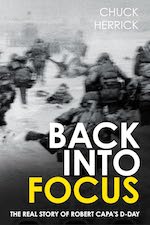
Charles Herrick, Back into Focus (2024), cover
In 2024 military historian Charles Herrick published Back into Focus: The Real Story of Robert Capa’s D-Day, a book-length distillation of his extensive and invaluable contributions to the Capa D-Day project here at Photocritic International. (You’ll find my review of the book here.)
To augment the book, Herrick established his own website, Charles Herrick Books. This site’s opening page includes links to a substantial interview with Herrick at YouTube channel WW2TV, hosted by Paul Woodage; another lengthy video podcast hosted by Joe Muccia on his “We’re Not Lost, Private” Podcast (episode 29) on YouTube; and an audio-only interview hosted by Angus Wallace on his WW2 Podcast YouTube channel (episode 266). If you’ve hesitated to dive into the military issues Herrick has explored here at the blog, his clear prose notwithstanding, perhaps you’ll find these conversational, dialogic synopses of the salient points less daunting and more accessible.
On the other hand, if you’re a glutton for punishment and actually want more of Herrick’s analyses of the invasion, his site includes a blog for that. In it he explores military matters relating to the invasion but not specifically connected to the Capa myth.
•
The Capa D-Day Project on Youtube
I’ve aggregated a number of videos related to our investigation at a Youtube channel titled “Robert Capa D-Day Project.” This includes nine interviews with John Morris reiterating his version of the myth. Viewing a batch of these back in 2014 set me off on this inquiry. Click on the link above if you want a sampling.
(Part 1 I 2)
•
This post sponsored by a donation from Bill Polkinhorn.
•
Special offer: If you want me to either continue pursuing a particular subject or give you a break and (for one post) write on a topic — my choice — other than the current main story, make a donation of $50 via the PayPal widget below, indicating your preference in a note accompanying your donation. I’ll credit you as that new post’s sponsor, and link to a website of your choosing.
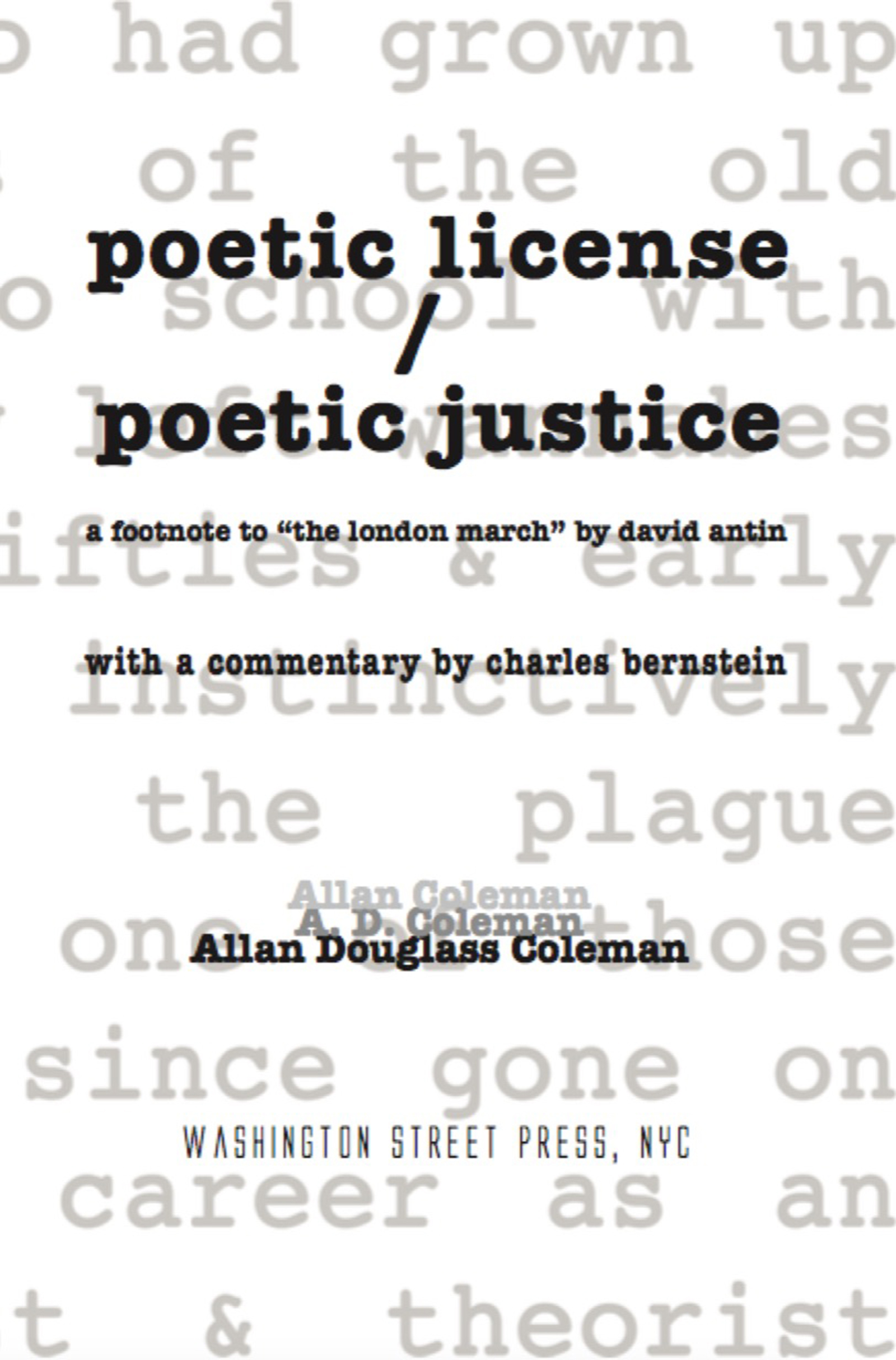
And, as a bonus, I’ll send you a signed copy of my new book, poetic license / poetic justice — published under my full name, Allan Douglass Coleman, which I use for my creative writing.

Leave a Reply