 [Duane Michals (February 18, 1932-June 9, 2026) died on June 9 in Manhattan. He was 94. For his New York Times obituary by Richard B. Woodward, click here. It includes a excellent cross-section of his work.
It’s likely that Duane and I crossed paths shortly after I hung out my shingle as a photography critic for the Village Voice in May of 1968 — the minuscule size of the New York City photo scene at the time meant that one soon met most of those active members who made themselves publicly visible. But I first recall meeting and being introduced to him at the March 1969 opening show of the the Lee Witkin Gallery in its original location at 237 East 60th Street in Manhattan — a group exhibition, “Spectrum I,” that included works by Michals, Scott Hyde, George Krause, George Tice, and Burk Uzzle.
Michals’s portion of the show consisted of images taken in an Eskimo village that — aside from a certain deadpan quality — in no way prefigured what would come, nor suggested the arrival of a major influence on the field.

Witkin Gallery, original logo (1969)
I reviewed that show for the Voice, and subsequently reviewed numerous books and exhibitions by Michals. I used his work to exemplify what I dubbed the “directorial mode” in photography in an influential 1976 essay for Artforum; included a selection of his work in my 1977 book The Grotesque in Photography; reprinted several reviews of his work in my 1979 collection Light Readings; reviewed other books and shows for various publications as the years went on; moderated a 1989 dialogue between him and Joel-Peter Witkin; and published several feature articles profiling him and discussing his body of work. In 2000 I delivered an encomium celebrating him at the National Arts Club in Manhattan, already published at this blog. Along the way, Duane and I met and talked on numerous occasions.
The essay below was a response to “The Duane Michals Show,” a 1993 touring retrospective curated by Arthur Ollman of the Museum of Photographic Arts in San Diego, CA. It appeared first in The Photo Review, Vol. 16, no. 2, March 1993, and then in Camera & Darkroom Photography, Vol. 15, no. 11, November 1993. — A.D.C.]
•
Duane Michals: Dangerous Thoughts
Duane Michals is fond of conundrums, as his widely exhibited and extensively published body of work makes clear. Yet there’s one riddle embedded in the very trajectory of his activities over the past three decades to which his numerous shows and monographs offer not even a clue, much less a provisional answer, and of which, in fact, they seems unaware: How did he get here from there?
“Here” is Michals’s position as a lifelong pioneer in the exploration of the directorial mode, sequential options and image-text relationships in photography, and as our best-known public meditator on the illusory nature of photographs. “There” is the set of images of people he made in the Soviet Union in 1958, some of the first photos he ever produced: simple, well-crafted street scenes and formal portraits that are not much different stylistically from what would shortly follow, but whose apparent purpose — straightforward documentation and description — is infinitely more naïve.
No substantial developmental bridge between the two is proposed by his books and exhibits, and while Michals has occasionally offered one in his exuberant lectures and interviews what it seems to boil down to is that, not long after he began to engage with this medium, he simply opted to step sideways into an alternative photographic universe.
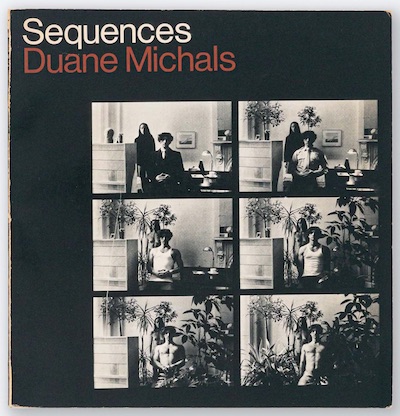
Duane Michals, sequences (1970), cover
“That was the ABCs,” he told an audience several years ago, for example, speaking of that pre-1960 imagery. “Then I started doing portraits and then one thing led to another. Ultimately that was unsatisfying because the events in my life, things that I found important, I would never find on the street. I had to invent them. Never having gone to photography school, I didn’t learn that I wasn’t supposed to do this. Nobody told me this was not to be done, so it was just very natural for me to do it. I’ve never been a reportage photographer.”
Nor would anyone think of him as such. Almost from the outset, Michals embraced the theatrical frame and the directorial mode; for him the viewfinder is a proscenium, models are dramatis personae. Another benchmark of his work is its exploration of the forbidden. A third is his insistence on stretching the boundaries of what a photograph is allowed to be. A fourth is the profoundly sacral essence of his seemingly profane and deeply disturbing vision.
One must use the word “naïve” cautiously in speaking of Michals’s work, as I did a few paragraphs earlier, because a posture of ostensible naïveté became a central feature in his work early on and remains so to this day. Much of his oeuvre addresses the vulnerability of innocence and the loss thereof — sexual, chronological, philosophical. Too, there’s a willful naïveté in his visual imagery, which is so constructed as to be (content aside) virtually devoid of anything that could be considered a “signature style.” Using a 35-mm. camera, he works almost exclusively in black and white (though “The Duane Michals Show,” his traveling retrospective, contains several color images, and half a dozen examples of his mixed-media pieces, in which he applies oil paint to silver gelatin prints).
And the techniques he employs to achieve certain effects — blur, double exposure — are all inherently photographic, and are produced in the camera, not in the darkroom. (This economy of means extends to his consumption of film as well. “I only shoot maybe one or two rolls when I do an idea,” he asserts, “because to me the hard part is figuring out the idea. I don’t consider photography [to begin] the moment I pick up a camera. That’s the easy part. The whole other part of thinking and putting it together in my mind is the hard part. And when I finally do it there’s no fat, there’s no wasted motion, it’s all there.”)
 Furthermore, the voice that he has evolved as a writer — the sometimes omniscient, sometimes first-person narrator of the prose and verse texts that are integral components of many of his pieces — maintains, at its best, a difficult, delicate balance between adult realism and youthful dreaming in which the wide-eyed idealism of the child is cherished without being venerated, while a mature, often mournful pragmatism refuses to descend into the cynical. Perhaps Michals’s most significant creative achievement is the precise coordination between his prose voice and his imagistic sensibility.
Through those intertwined communication systems he has enabled himself to address an assortment of recurrent concerns that were not previously assumed to be accessible to photographic investigation: such metaphysical ones as the mysteries of sex and death, the limitations of photography as a recordative system, the cyclical nature of human experience, and synchronicity; such autobiographical ones as obsession, guilt and redemption, sexual repression and oppression, and the taboo.
•
Bing Crosby used to say that he strove to sound like just another guy singing in the shower. There’s an aspect of that in Michals’s attitude: the voice of his work has an everyday, average-Joe quality that makes the viewer/reader feel that he or she could have made those images, written those words, thought those thoughts. And perhaps that’s true. Michals can easily be accused of stating the obvious; but the obvious often doesn’t become so until it’s identified, put into words. More trenchantly, he stands convicted of sometimes missing his step and falling into the faux-naïf and even the downright dumb, as I feel he does in some of his painted photographs, in his recent fairy tales for children and doggerel pieces, and in an overblown film-noir spoof, “Amazing Rick Dick,” starring Richard Gere, Cindy Crawford and Joel Grey.
Yet while I’m disenchanted with these aspects and/or examples of his work, I find his oeuvre exhilarating overall. Michals has been more willing than most photographers — indeed, more than most artists in any media — to make his process public, to fall on his face, and to disclose the results of his experiments, including those that fail as well as those that succeed. Sometimes he does not seem to know the difference. But he also enjoys playing the fool, and one function of his visible failures and high-profile tomfoolery is to take the pontifical edge off his philosophizing; so there’s a certain method to his madness.
However, as “The Duane Michals Show” makes clear, the best of Michals’s work is plentiful, substantial, and durable. This survey, which I saw in New York in the fall of 1992 at the International Center of Photography’s uptown headquarters, has now finished its extensive U.S. tour, during which it was seen by many of this magazine’s readers; a Japanese itinerary is presently in the planning stage. Though not accompanied by a catalogue per se, much of what it includes can be found in his three most recent books, all from Twin Palms Publishers: Album: The Portraits of Duane Michals, 1958-1988; Now Becoming Then; and Eros and Thanatos.
•
It is perhaps difficult for the current audience — especially its younger members — to understand how controversial much of this work was when it first appeared: Michals’s explorations of staged events, extended forms and image-text integrations, in particular, were challenging and seminal, exerting a powerful influence on photographers and artists alike from the time they made their first appearance in the late 1960s. He’s been a living example of his own proposition: “Either you are defined by your medium or you must redefine it.”
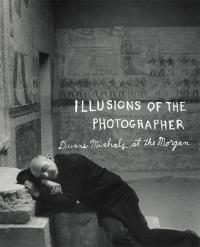
Duane Michals, Illusions of the Photographer (2019), cover
Formal innovation, dialectical inquiry and intimate confessionalism are conjoined in Michals’s work; all are integral to it. As with his photography, his structural means are simple. He works in some cases with self-contained units of a single image with text, at others with suites of related image-text pieces (such as “I Remember Pittsburgh,” in which he revisits his family and hometown) or linear, cinematic sequences. The texts that accompany these, meditative yet conversational in tone, are hand-written directly onto the borders of the prints, thus anchoring their source in the personal and autobiographical. They serve as soundtracks or voice-overs for these vignettes, mini-myths and epics. In a few cases, such as “A Failed Attempt to Photograph Reality” and “Shopping with Mother,” the work consists solely of a photograph of one or more paragraphs of text.
Though its text is embedded directly in the image, the 4-print sequence “Someone Left a Message for You” from 1974 is a good example of his ability to make much with such minimal means: It reveals, progressively, a hand writing out a sentence, word by word, apparently backwards. The viewer/reader must decipher the message by “righting” in the mind that reversed text — which, when completed, states, “As you read this, I am entering your mind.” In its intellectual complexity and elegant simplicity, a work like this — or, to give another example, the virtuosic, self-reflexive juggling of scale in “Things Are Queer” from the preceding year — prefigures (and, by and large, outdoes) most of the subsequent two decades’ worth of “conceptual” work by photographers and artists using photography.
That his achievements in that regard are finally being recognized simply confirms his own faith in the necessity of long-term commitment to one’s own work. To an audience of (mostly) aspiring younger photographers a few years ago, Michals (who will turn 62 next February) said, “The thing is you have to realize, if you’re interested seriously — and I’m not talking about being this year’s pretty face or this year’s fashionable name — you’ve got to be in it for the long run. You have to be an artist at thirty-five, you’ve got to be an artist at forty-five, and fifty-five, and eighty-five. You don’t do it for this week. That’s called being a dilettante.”
Those who have followed this photographer’s work over the past thirty years could find many old favorites in the large-scale “Duane Michals Show,” including early classics like “Fallen Angel,” “Chance Meeting,” and “The Journey of the Spirit After Death,” along with such later efforts as his exploration of fetishism, “The Pleasures of the Glove” and the parodic “I Build a Pyramid” (the last-named from his Egyptian project). There’s also a wall’s worth of his subtle, insightful portraits of such luminaries as Magritte, Warhol, Joseph Cornell, Dennis Hopper, François Truffaut, and many others. However, not all of Michals’s most noted works are included here. Absent, for instance, are “Alice’s Mirror,” another intricate perceptual puzzle, and any extract from “Homage to Cavafy,” a touching tribute to the Greek poet that represented Michals’s official coming-out as an openly gay artist.
•
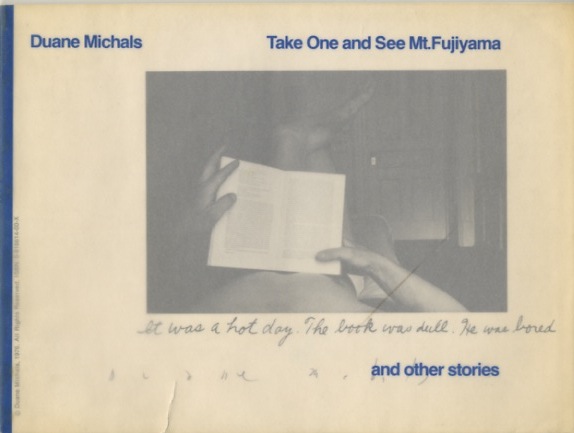
Homosexuality is a central issue in his work, but only one of many. And, notably, love, lust and loss are treated by him as universals. Though unabashedly homoerotic (most touchingly, for me, in such pieces as the simple 5-print suite from 1986, “How Nice to Watch You Take a Bath”), Michals is capable of considering with equal tenderness “The Most Beautiful Part of a Woman’s Body,” and of concocting a deliriously comic heterosexual wet dream, “Take One and See Mt. Fujiyama.”
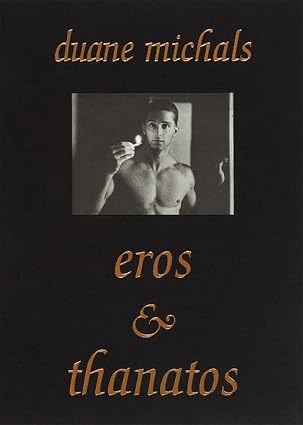
Duane Michals, eros & thanatos (1992), cover
Thus, while gayness colors his understanding of a variety of human experiences, ranging from erotic desire to parent-child relationships, it does not become a boundary restricting him from empathetic projection into the lives of others — or discouraging their identification with his. I can think of no other photographer, gay or straight, whose self-scrutiny has had an equally transformative, liberating effect on the lives of so many people of both genders and all persuasions. As the photographer proudly admits, his work exemplifies the dread “secular humanism” now being demonized across the land, and one can see why; its gentle sufferance accepts what is worst in people and speaks to what is finest in them.
This is not to say that he is all peaches and cream. His opinions can be scathing. He considers Cindy Sherman to have been “the perfect photographer for the Reagan era because [her work] is about nothing. It’s like his politics. There’s nobody there.” Of Robert Mapplethorpe he says, scornfully, “What Frederick’s of Hollywood is to heterosexuality, this stuff is to homosexuality.” But Michals’s rare flashes of deep anger are directed almost exclusively at organized religion, especially Christian fundamentalism. “There is no bigger bigot than a professionally religious person,” he snaps. “They’ll kill you because Christ told them to, which is the worst.”
Doubtless it was his idiosyncratic combination of prickliness and tolerance that earned him one of the more unusual opportunities offered to a photographer in recent times. On Saturday, July 6, 1990, Michals published on the Op-Ed page of the New York Times a photograph showing a man wearing a priest’s collar holding a crucifix as if it were a gun and pressing it to another man’s temple. In a statement accompanying this image, which he described as an “allegory,” Michals indicated that it
reflects my anger at coercive behavior by some of my fellow citizens. No American has the right to impose his private morality on any other American, yet this is precisely the political agenda of some religious groups.
Millions of women have become victims of attacks on their most painful, private choice of conscience: whether to have an abortion.
Millions of homosexuals and lesbians have become victims of attacks on gay rights legislation, denying them fundamental rights to housing and employment, which heterosexual America takes for granted.
This piece drew bagsful of mail, much of it from the religious right; the editors of the Times were intimidated enough thereby to offer a mealy-mouthed apology for offending anyone by publishing it. Michals felt no need to make amends. Though deeply concerned with spiritual matters — sin, guilt, redemption, transcendence, reincarnation are all recurring themes in his work — he has little patience with religious orthodoxies. “I’m an ex-Catholic,” he explains. “In fact, I’m the ex-est of all Catholics. You must remember that churches are political institutions designed to control people’s behavior. Artists by their very nature are liberators. It’s inconceivable that somebody could be a good Catholic and also be a good artist, except for Michaelangelo. But he was a terrible Catholic. Anyway, the point I’m making is that artists ask questions. Artists don’t accept answers that they get. I simply asked my way out of the church. I used to mea culpa myself to death too. Then I realized that I wasn’t getting answers that I wanted. Once you stray beyond the wagons, then you’re on your own. … ”
•
As another of our pioneering explorers of the forbidden, Joel-Peter Witkin, wrote to me, “What makes Duane’s work important is that he risks everything in order to be his most honest and creative Self. He has the courage to be vulnerable — to feel and love responsibly — to respond to his deepest, impending reality. He is also, like me, a ‘traditional’ photographer, in that the well-spring of his vision is related principally through the photographic process — connecting with all its historic and aesthetic lineage.”
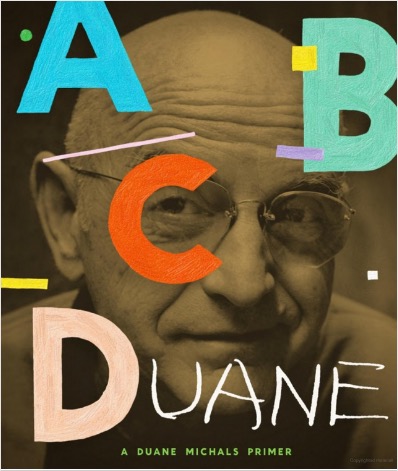
Duane Michals, ABCDuane (2014), cover
That vulnerability of which Witkin speaks was clearly, and intentionally, built in to “The Duane Michals Show.” The exclusion of many of the photographer’s best-known pieces — and the presence of more recent, less resolved, even unsuccessful works — combined with the texts he’s graffitoed directly onto the walls (including a doggerel diatribe against “Rat Buchanan”) to convey an overall sense of work-in-progress. That’s clearly how Michals wants the viewer to understand his photography — and, I suspect, how he himself wants to be perceived as well.
In any case, it helps generate an atmosphere of the intimate and personal that is sustained throughout this 200-print exhibit; that’s no mean feat, and is a tribute to both Michals’s emotional openness and the curatorial intelligence of Arthur Ollman, Executive Director of the Museum of Photographic Arts in San Diego, where this exhibit originated. (Note: Ollmann informs me that the version of the show presented at the ICP had been cut from the original by roughly one-third, and that five new pieces had been added without consultation with him. This raises significant questions concerning institutional respect for the curatorial integrity of traveling exhibits at the ICP.)
At his best — which is surprisingly often, given his prolificity — Michals strikes a note of frankness, poignancy, compassion and yearning that is forthrightly humane, profoundly eloquent and deeply resonant. “Remember that everything is a subject for photography,” he suggests, “including your own fantasies, your own truth, your own desires, your own fears. That’s where you live. You don’t live on the streets looking at people’s faces or looking at sunsets. You live in your mind. And you know your fears more intimately. What I want from you is your secrets. That’s the only thing you can give me: your secrets.”
I’m reminded of something Sherwood Anderson, one of the finest American writers of this century, once wrote:
It would be an amazingly beautiful thing to have happen in the world if everyone, every living man, woman, and child, should suddenly, by a common impulse, come out of their houses, out of the factories and stores, come, let us say, into a great plain, where everyone could see everyone else, and if they should there and then, all of them, in the light of day, with everyone in the world knowing fully what everyone else in the world was doing, if they should all by one common impulse commit the most unforgivable sin of which they were conscious, what a great cleansing time that would be.
That’s a dangerous thought. And no matter how affable, mild-mannered, and goofy he may appear to be, a man who thinks like that — Duane Michals certainly being one — is a dangerous man.
•
This post sponsored by a donation from Carlyle T.
•
Special offer: If you want me to either continue pursuing a particular subject or give you a break and (for one post) write on a topic — my choice — other than the current main story, make a donation of $50 via the PayPal widget below, indicating your preference in a note accompanying your donation. I’ll credit you as that new post’s sponsor, and link to a website of your choosing.
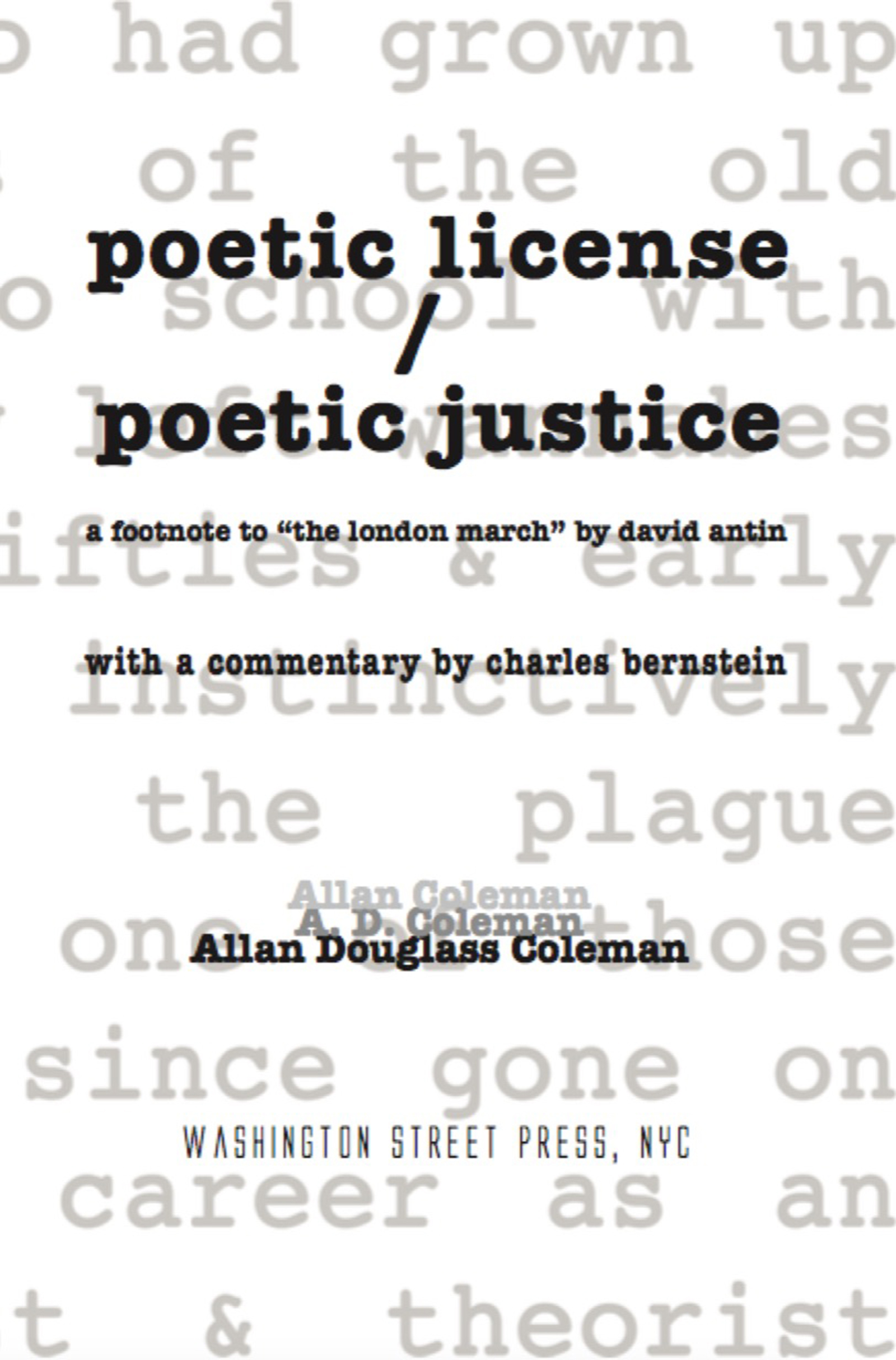
And, as a bonus, I’ll send you a signed copy of my new book, poetic license / poetic justice — published under my full name, Allan Douglass Coleman, which I use for my creative writing.

Leave a Reply