 [The end of my stints as photo critic and columnist for the Village Voice (1968-73) and the New York Times (1970-74) effectively terminated my running commentary on the emergent photo scene in New York City and, more broadly, across the U.S.
Among the unexpectedly positive consequences of these abrupt, unwelcome changes in my professional situation, these stood out:
- Freed from the pressures of weekly/biweekly deadlines, I could work in a more meditative fashion, letting an essay gestate while crafting my work more carefully.
- Freed from the constrictions of space for newspaper columns, I could write more expansively, addressing my subjects at greater length.
- Freed from the journalistic obligation to cover a reasonable cross-section of local exhibitions and new books, I could pick and choose the issues with which I wanted to engage.
In other words, for the first time in my professional life I could write whatever I wanted to write, developing my ideas at my own pace, employing a more essayistic style, without needing to tie a given piece to some newsworthy occasion. (How I would make a living at this I’d have to figure out as I went along, of course.)
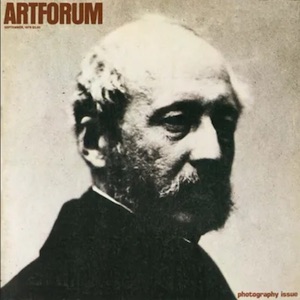
Artforum, Photography Issue (September 1976), cover
One result of this transition took the form of the essay below, published exactly 50 years ago in Artforum. I wrote it because I needed it as a reference point for my critical writing about a tendency I saw emerging in contemporary photographic activity. I still thought of myself as a critic and not a historian, but needs must, so this also marks my entry into historianship of photography, complete with footnotes.
Half a century on, this stands as my most widely circulated, most anthologized, most frequently assigned, and most cited essay. This article first appeared in print in Artforum, 15:1, September 1976, pp. 55-61. Subsequently I republished it in my 1979 collection, Light Readings: A Photography Critic’s Writings, 1968-78. This is the first of two parts. Click here for Part 2.— A.D.C.]
•
The Directorial Mode: Notes Toward a Definition (a)
Within the century and a half of photography’s history, two recurrent controversies have had strong influence on its evolution into a graphic medium with a full range of expressive potential. These conflicts, centering around issues which have masqueraded as debates over style and even technique, are, in fact, philosophical clashes. The first — which for all intents and purposes is finally over — was the fight to legitimize photographic imagery per se as a suitable vehicle for meaningful creative activity.
The initial stage of this fight had more to do with the art establishment’s defensive antagonism toward photography than with the practitioners’ attitudes toward the medium, or the public’s. The general public has always been interested in looking at photographs, even (perhaps especially) at photographs which were not certified as Art. The problem has never been the lack of an audience, but rather the withholding of certain kinds of incentives: prestige, power, and money.
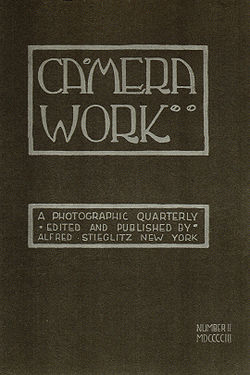
Camera Work No. 2 (1903)
The morphology of photography would have been vastly different had photographers resisted the urge to acquire the credentials of aesthetic respectability for their medium, and instead simple pursued it as a way of producing evidence of intelligent life on earth. However, photographers — some of them, at least — have chosen to enter the “artistic” arena. So there have been cyclical confrontations between the dominant public definitions of art at various times and photography’s concurrent definition of itself.
Though he was neither the first nor the last to take up these cudgels, the key figure in our century was that decidedly bourgeois gentleman with aristocratic tendencies, Alfred Stieglitz. Stieglitz desired — noblesse oblige — to lead a crusade; his was for the acceptance of photography as High (Salon) Art. At the time he embarked on his quest, the most rampant forms of High Art were recognizable via adherence to conventions of subject matter and style, among them livestock in rural settings, sturdy peasants, fuzziness, and orientalia.
Initially, it appears, what Stieglitz meant by Art Photography was imagery resembling Whistler prints or genre paintings, or both — at least to judge by his own early work and the photographs by others which he presented in Camera Notes and Camera Work, the major critical organs which he edited (and, in the case of the latter, published). He and his cohorts successfully addressed these accepted themes and evoked the requisite mannerisms from their medium, which is, in fact, adaptable enough to almost any end to make even that possible. The final result, however, was an attenuated school of photography based on imitation of the surface qualities of a nostalgic, enervated school of painting.
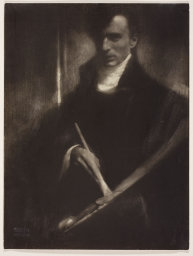
Edward Steichen, “Self-Portrait with Brush and Palette,” 1902
That this definition of both High Art and High Art Photography was a creative dead end eventually became apparent. (Indeed, it becomes increasingly apparent that the battle for the acceptance of photography as Art was not only counter-productive but counter-revolutionary. The most important photography is most emphatically not Art.) And whereas Stieglitz began by advocating and sponsoring a brand of photography which still exists in the antiquated and slightly debased form of camera-club pictorialism, he subsequently became aware of — and, to his credit, embraced — that ferment in which post-impressionist seeing and camera vision commingled to generate radical new forms of visual expression. So he ended up proselytizing for a way of working in photography which was diametrically opposed to what he had initially propounded; the last issues of Camera Work were devoted to the blunt, harsh, Cubist-influenced early images of the young Paul Strand.
Strand and others, both here and abroad, were persuaded that different media were much like sects, to whose dogma practitioners should hew closely, and that a medium was best defined by its inherent and unique characteristics — those aspects which were shared by no other. Curiously, they did not consider photography’s almost infinite adaptability to any style of expression as such a characteristic, but settled instead on the related (though not identical) qualities of sharpness of focus and realism. And, as purists tend to do, they made of these qualities not merely stylistic choices but moral imperatives.
This was an approach to photography which found corollaries in many art and design movements around the world; its connections with no-frills utilitarianism, form-following-function theories, and the general mechanophile tendencies in literature and the arts are self-evident. Coincidentally, it also happened that at the same time photographic historiography was beginning to evolve from the purely technical to the chronological and aesthetic. (The next stage, the morphological, is only now beginning to be reached.)
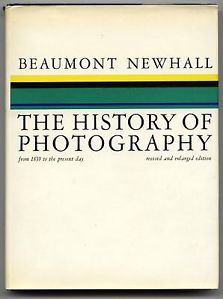 Photography, being a hybrid medium, looked at askance by the art establishment almost everywhere except the Bauhaus, received remarkably little attention as a field of scholarly and critical inquiry, a situation which persisted until the beginning of this decade. So, incredible as it seems in retrospect, during the 1930s the historiography of the most radical innovation in communication since the invention of the printing press and the most democratically accessible image-making tool since the pencil was vested in a mere handful of people — somewhere between six and twelve, depending on how you count.
Inevitably infected with the aesthetic Zeitgeist, these historians were understandably anxious to prove that their medium was distinct from its predecessors in the graphic arts and yet directed toward the same field of ideas as was the vanguard of the arts in general at that point. Naturally, then, they explicated the development of photography as apostles of realism. The rest, one might say, is history — though what they wrote, in most cases, more nearly approaches theology.
•
People believe photographs.
Whatever their response may be to sculptures, etchings, oil paintings, or wood-block prints, and regardless of the level of sophistication they bring to encounters with such works, people do not think them credible in the way they do photographs.
Their credence is based on many factors. These are a few:
- Photography institutionalizes Renaissance perspective, reifying scientifically and mechanistically that acquired way of perceiving which William Ivins called “the rationalization of sight.” Thus photography reassures us constantly that our often arbitrary procedures for making intellectual sense out of the chaos of visual experience “work.”
- Although in its physical form the photographic print is nothing more than a thin deposit of (most commonly) silver particles on paper, the image composed thereby does encode a unique optical/chemical relationship with a specific instant of “reality.” Remote and equivocal it may be, but undeniable. A certain lack of aesthetic distance is virtually built into the medium.
- The mechanical, non-manual aspects of the process combine with the verisimilitude of the rendering to create the illusion of the medium’s transparency, or, as Ivins put it, its lack of “syntax.”
After all, infants, lower primates, and even servo-mechanisms can take photographs that display the qualities just cited. Photographing appears to be nothing more than concretized seeing, and seeing is believing.
These and other factors have, from its inception, created an atmosphere around photography within which the medium’s credibility is not to be questioned — not lightly, at any rate. The assumption has been that the photograph is, and should properly remain, an accurate, reliable transcription. This, of course, is restrictive and inhibiting to some image-makers, who have refused to accept love-it-or-leave-it dicta from the medium’s purists. So photography’s second major struggle has been to free itself from the imperative of realism.
Viewing this crucial philosophical relationship to photography (and, implicitly, to reality) in terms of a continuum, we can say that at one end there is a branch of photography concerned with justifying the medium’s credibility. It operates as an essentially religious discourse between image-maker and viewer. It involves an act of faith on both parts, requiring as it does the conviction that the image-maker has not significantly intervened in the translation of event into image. In responding, the viewer is not supposed to consider the image-maker’s identity, but only the original event depicted in the image. The photographer’s choice as to which (and what sort of) events to address is the only personal, subjective evaluation permitted in this mode. All other aspects of presentation are supposed to be neutral; a high degree of technical bravura is acceptable in some circles, but anathema in others.
We have long attached to images in this mode — and must now laboriously disengage from them — two misleading labels: documentary and straight/pure. The former is generally applied to images depicting human social situations, the latter to formal, studied images of traditional graphic-arts subject matter — nudes, still lifes, landscapes, portraits. I would tentatively suggest that we consider the terms informational and contemplative/representational, respectively, as somewhat more accurate replacements.
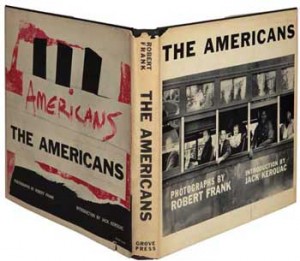
Robert Frank, “The Americans,” first U.S. edition, 1959.
In its relationship to the photograph’s credibility, this latter mode might be described as theistic. Another, an agnostic one, permits a more active intermediation between the Ding an sich and the image. Here there is no great leap of faith required; the image-maker openly interprets the objects, beings, and events in front of the lens. The subjectivity of these perceptions is a given, as is their fleetingness. A certain amount of chance and accident is also accepted in this method, sometimes even courted; for photographers, like politicians, tend to take credit for anything praiseworthy that happens during their administrations.
The viewer’s engagement with these images usually involves a conscious interaction with the photographer’s sensibility. However, the photographer is still presumed not to interfere with the actual event going on, though in some situations — especially if the event in question is taking place within the photographer’s personal/private life, rather than in the “outside world” — that line is hard to draw. In theory, such a photographer is simply free to impose his/her understandings of — and feelings about — the “real” event onto the image thereof; the viewer is made equally aware of both.
We have no labels specifically attached to this mode; its practitioners have been categorized according to other systems. Among them I would include Robert Frank, Dave Heath, Brassaï, André Kertész, Manuel Alvarez Bravo, Henri Cartier-Bresson, Sid Grossman, W. Eugene Smith — quite a mixed lot in terms of subject matter and style, but attudinally related. William Messer has proposed the use of the term “responsive” to define this mode.
•
A third, atheistic branch of photography stands at the far end of this continuum. Here the photographer consciously and intentionally creates events for the express purpose of making images thereof. This may be achieved by intervening in ongoing “real” events or by staging tableaux — in either case, by causing something to take place which would not have occurred had the photographer not made it happen.
Here the “authenticity” of the original event is not an issue, nor the photographer’s fidelity to it, and the viewer would be expected to raise those questions only ironically. Such images use photography’s overt veracity against the viewer, exploiting that initial assumption of credibility by evoking it for events and relationships generated by the photographer’s deliberate structuring of what takes place in front of the lens as well as of the resulting image. There is an inherent ambiguity at work in such images, for even though what they purport to describe as “slices of life” would not have occurred except for the photographer’s instigation, nonetheless those events (or a reasonable facsimile thereof) did actually take place, as the photographs demonstrate.
Such falsified “documents” may at first glance evoke the same act of faith as those at the opposite end of this scale, but they don’t require the permanent sustaining of it; all they ask for is the suspension of disbelief. This mode I would define as the directorial.
There is an extensive tradition of directorial photography as such. But directorial activity also plays a part in other modes as well. I would suggest that the arranging of objects and/or people in front of the lens is essentially directorial. Thus I would include most studio work, still lifes, and posed nudes, as well as formal portraiture, among the varieties of photographic imagery which contain directorial elements. Edward Weston was not functioning directorially when he photographed a dead pelican in the tidepools of Point Lobos, but he surely was when he placed a green pepper inside a tin funnel in his studio; and he was doing so consciously when he made his wartime satires (such as “Dynamic Symmetry”) or the 1931 image which he felt it necessary to title “Shell and Rock (Arrangement).”
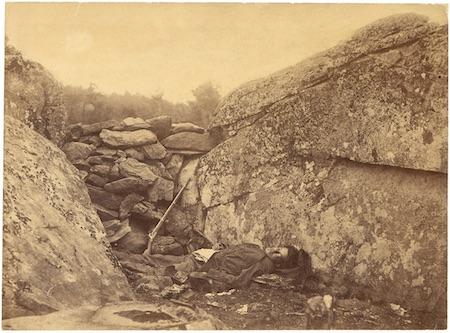
Alexander Gardner, “Home of a Rebel Sharpshooter” (1863)
•
When — as evidence from other photographs indicates — Alexander Gardner moved the body of a Confederate soldier for compositional effect to make his famous image “Home of a Rebel Sharpshooter,” he was functioning directorially. So was Arthur Rothstein when, by his own testimony, he told the little boy in his classic Dust Bowl photograph to drop back behind his father. So was the late Paul Strand when — according to reports — he “cast” his book on an Italian village, Un Paese, by having the mayor of the town line up the residents and picking from them those he considered most picturesque.
The substantial distinction, then, is between treating the external world as a given, to be altered only through photographic means (point of view, framing, printing, etc.) en route to the final image, or rather as raw material, to be itself manipulated as much as desired prior to the exposure of the negative.
It should be obvious from the above example — and many more could be cited — that directorial elements have entered the work of a vast number of photographic image-makers, including many who have been taken for or represented themselves as champions of documentary/straight/pure photography. Things are not always as they seem; as Buckminster Fuller says, “Seeing-is-believing is a blind spot in man’s vision.” …
(Part 1 I 2)
•
Special offer: If you want me to either continue pursuing a particular subject or give you a break and (for one post) write on a topic — my choice — other than the current main story, make a donation of $50 via the PayPal widget below, indicating your preference in a note accompanying your donation. I’ll credit you as that new post’s sponsor, and link to a website of your choosing.
And, as a bonus, I’ll send you a signed copy of my new book, poetic license / poetic justice — published under my full name, Allan Douglass Coleman, which I use for my creative writing.
[donateplus]

I was taking notes… came up with these 3 points to discuss.
~~~~~~~~~~~
People believe photographs.
So photography’s second major struggle has been to free itself from the imperative of realism.
(Conditions for its credibility)
“image-maker has not significantly intervened in the translation of event into image.”
~~~~~~~~~~~
Realism – can it not be enlarged to include things that cannot be comprehended as being real, even though it’s barely visible?
I’m now working on “new” realism at the micro-graphic level, where the optics perform a new, and unfamiliar interpretation of the real, and one which is barely comprehensible unless they’ve experienced the world through the optics of microscopes.
Those images were previously (almost exclusively) “specimens” and not objects/subjects, and their understanding is helped by facts, but not so much as to fully enjoy the image as art.
Also, in my work, the “out of focus” areas (OOF) become an equivalent to negative space in a 2D artwork.
P.S. I consider AI as the catalyst to provoke new ways for the camera and photographers to expand the medium. The process will likely (?) follow that of painting after about 1860, when photography took over realism.
Thank you for re-posting this marvellous essay.
Some of the points raised here shed light on an issue with which I continue to struggle: the implications of describing (and thinking of) photographs as “taken”.
As you correctly note, there is an assumption that photographs are (normally) accurate, reliable transcriptions of the things in front of the lens. But when a photo-mechanically accurate depiction of scenes produce results which differ substantially from the way in which they appear to us, can we argue that they were not ‘taken’ but were instead created by the act of photographing them?
Again, with very sincere thanks for your invaluable contribution to our understanding of photography.
https://www.lensculture.com/projects/1907082-technical-images-of-flux
For exactly that reason, I prefer to use “description” instead of “transcription” when referring to the act of photographing and the resulting images. I use “translation” for the same purposes.
The understanding that — even when generated by servomechanisms at random intervals — photographs get “made” rather than “taken” seems to me the necessary starting point for any sensible discussion of the medium.