
[Today, June 6, 2026, marks the 82nd anniversary of D-Day and the twelfth anniversary of this Capa D-Day research project.
It’s not a milestone year for the invasion, so I don’t anticipate much in the way of media commemoration. I will do my usual search tomorrow, nonetheless, and will report thereon in a later post. Instead, I’ll use this occasion to address a challenge to our research.
In May 2025 photographer and battle surgeon Timothy Floyd initiated a blog at his website, Aid and Comfort to the Enemy: A Surgeon’s View of the War in Iraq, and Other Essays. For its debut, he chose to publish a lengthy series of posts disputing the research and conclusions that we have presented in “Alternate History: Robert Capa on D-Day.” He titles his series “Robert Capa Focus Hocus-Pocus.”
Speaking for my colleagues as well as myself, we welcome all serious responses to our 12-year-long project, whether pro or con. I intended to respond to Floyd’s posts at length and in chronological order. However, earlier this year he took them offline. This past April he posted a new installment that remains live online. And, in advance of D-Day, as a teaser for a forthcoming book from the University of Missouri Press, the website L’Oeil de la Photographie (The Eye of Photography) published an article Floyd wrote summarizing his research. (It will be online with free access only through the D-Day weekend 2026. I should note that until now this website has turned a blind eye to our project.)
Deconstructing all the arguments Floyd summarizes in his article seems pointless, as they appear there in skeletal form, not fleshed out. Also, unless you access it this weekend, it will get hidden behind a paywall. So, for now, I’ll concentrate on Floyd’s April post about the mythic “darkroom disaster,” and the section of the article devoted thereto. — A.D.C.]
•
Floyd Post 24: “The Darkroom Myth”
In this post, dated April 14, 2026, Floyd makes his second attempt at rationalizing the legendary darkroom disaster that supposedly “ruined” the bulk of Robert Capa’s D-Day coverage. (Floyd’s first swing at this took place in his twelfth post — currently offline, alas.)
Now, in this blog post, regarding the legendary loss of Capa’s films in LIFE‘s London darkroom, Floyd writes,
… Modern critics have tested film in heated drying cabinets with temperatures reaching over 300-degrees F with no evidence of emulsion melt. In fact, the acetate backing melts before the emulsion does at high temperatures …
I learned that a certain historian of photographic processes, whose identity I will disclose in a future post, recently had manufactured some 35-millimeter film using an emulsion formula from 1925. It did not include hardeners. Now, granted, this formula was probably not the same as the Eastman Kodak Super-XX that Capa used, but it is the closest that could possibly be had. This gentleman kindly provided two rolls to me for experimentation.
… I exposed the film and developed it in D-76, which was a common developer at that time. While wet, I hung one strip in a shower at 71-degrees F and placed the other strip in an oven set at 120-degrees. The first strip dried normally. The emulsion on the second strip began to melt after about two minutes. The entire strip did not begin melting all at once but it went from normal to melting very quickly. …
And in the Eye of Photography article he elaborates:
Photographic films of that era did not contain hardeners, possibly because these agents fouled the machinery used to manufacture the film. Hardeners could be added during processing, if necessary. Hardeners were not routinely added to photographic emulsions until the 1950’s, and it did not become standard practice until the 1960’s.
Several things worth noting here, as they typify Floyd’s overall scrupulousness, reasoning, research methodology, and editorial choices:
Tristan da Cunha, “Robert Capa and the mystery of the lost-photos” (2022), title screen (English)
• The unnamed “modern critics” who conducted the earlier tests to which Floyd refers was, in fact, the Capa D-Day team’s own Tristan da Cunha, who documented his tests thoroughly in an extensive video, accompanied by an equivalent illustrated text in pdf form, and available for free viewing and download here. Da Cunha undertook and designed these tests in consultation with photo historian Rob McElroy and myself. (Significantly, in this blog post and the Eye of Photography article Floyd provides no links to these prior experiments that he claims to disprove, or at least challenge, though they’re readily available online. Clearly he doesn’t want anyone looking at them side by side with his, as I would encourage readers of this post to do.)
• Floyd writes that, for his own experiment, he used a present-day 35mm film produced “using an emulsion formula from 1925. … granted, this formula was probably not the same as the Eastman Kodak Super-XX that Capa used, but it is the closest that could possibly be had.” [Emphasis added.] This is false and misleading. Vintage unexposed Super-XX film from the early 1940s can easily “be had.” I know that from personal experience, because I purchased on eBay the two rolls of said film — one from 1943, the other from 1944, thus contemporaneous with Capa and D-Day — on which da Cunha conducted his experiments. (Yes, I can bring the receipts.) And da Cunha’s documentation of his tests shows those films in their own original packaging, complete with dates of manufacture. Which Floyd carefully avoids mentioning, though he claims familiarity with da Cunha’s project.
• He elides those facts because they make it clear that his own experiments do not bear comparison with da Cunha’s in any meaningful way. Floyd knowingly used a small-batch, artisan-made present-day film based on a 1925 non-Kodak formula as a stand-in for actual Kodak Super-XX film, readily available to him, dating from roughly two decades later than that formula. And then, he adds casually, he popped one into a “small oven” to dry, using an oven thermometer to measure the temperature. How scientific of him. (Note: The films Floyd used came from Mark Osterman in Rochester, NY, as indicated by the “MO 1925” identifier in his illustrations.)
• Floyd implies thereby not only that his experiments parallel those of da Cunha, but that between 1925 and the early 1940s b&w film emulsions did not significantly evolve and improve. That is nonsensical on the face of it. No historian of b&w film manufacture would support that claim.
• He also makes a point of noting that “those early films … did not have much in the way of hardeners,” which substances (as the name suggests) have the effect of permanently hardening the emulsion of the film during and after processing, thus minimizing or entirely preventing any softening or melting due to heat in the drying process. This implies that da Cunha’s experiments involved the testing of films that contained and/or were processed with hardeners.
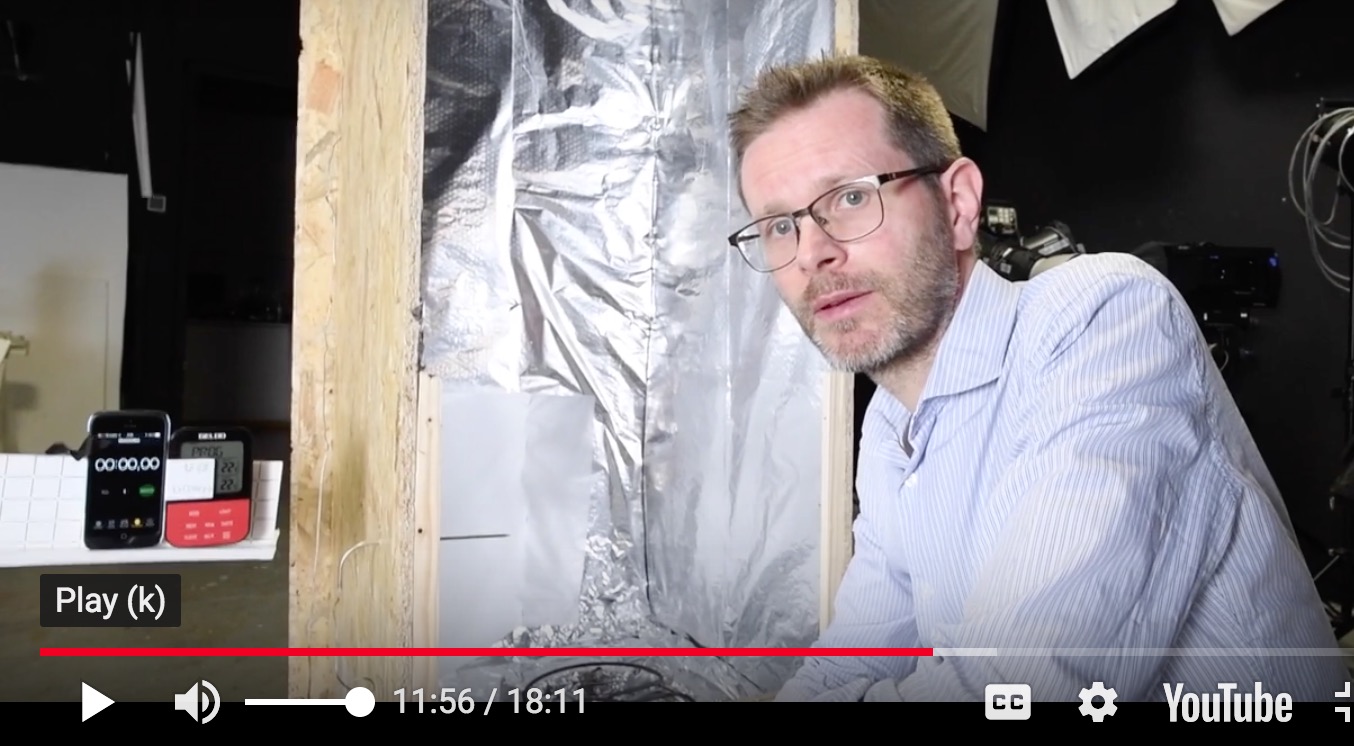
Tristan da Cunha with film drying test cabinet, 2021 (film still)
• However, da Cunha’s detailed documentation of his rigorous experiments states explicitly that in processing his Super-XX rolls he used Ilford Rapid Fixer, which does not contain a hardening agent. As he points out, even without a hardener the film withstood the heat of 130°C (266°F) for 30 minutes remarkably well. (Note: That’s more heat, for a longer time, than any commercial or homemade film-drying cabinet would normally pump out.)
• If the presence of any hardeners explains those particular rolls’ resistance to emulsion melt under high heat, therefore, it would have to involve hardeners added to the film by Kodak during production. In which case Capa’s films — made by the same company at the same time using the same formulas — would have contained those same hardeners. (For several expert opinions on hardeners of that period, solicited during the early phase of our investigation, click here.)
• Floyd also carefully neglects to mention that although Kodak did not add hardeners to its b&w films across the board until 1946, hardeners were frequently used in darkrooms of the time when processing films. Most commonly, hardeners would get added to the “fixing” solution that stabilizes and makes permanent the developed image on the negative, as Floyd surely knows. According to photo historian Rob McElroy, “All kinds of additional hardeners for use during processing were available in the 1940s for photographers to use depending on their choice of film AND their choice of developer.” (Email to the author, April 22, 2026.)
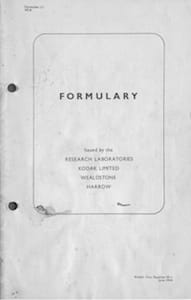
Kodak formulary, June 1944, page 01
• By the early 1940s Kodak manufactured its own branded hardeners, in both powder and liquid forms. You can download a pdf file of a June 1944 British Kodak Formulary here, “[i]ssued by the Research Laboratories Kodak Limited Wealdstone Harrow.” This pamphlet contains a complete list of Kodak film-processing chemicals available in the UK at the exact time of the D-Day invasion, plus formulas for their mixing and advice on their use.
• Notably, on p. 7 it lists “‘Kodak’ Rapid Fixer. For preparing a non-hardening acid fixing bath” along with “‘Kodak’ Acid Fixing Salts with Hardener. For preparing a standard hardening fixing bath for general work” [emphasis added], as well as three separate hardeners, including “‘Kodak’ Liquid Hardener. For addition to acid fixing baths.” [Emphasis added.] On p. 24 it advises, “As an alternative to preparing your own fixing baths, ‘Kodak’ Acid Fixing Salt with Hardener is available in powder form.”
• Clearly, processing film with a fixer-hardener combination was not just possible in 1944 but a widespread practice at the time, given that Kodak mass-produced several variant options for that specific purpose, one of them conveniently pre-packaged and promoted as “a standard hardening fixing bath for general work.”
• Technical note: Eventually Kodak would package its Rapid Fixer and Liquid Hardener concentrates together as a set for sale as a single unit, still available under the name Kodak Rapid Fixer, Solutions A & B for Black & White Film. According to photo historian Rob McElroy, “Rapid fixer is made with ammonium thiosulfate, which fixes film faster than powdered fixer, which is made with sodium thiosulfate. That is why I would assume most newspaper darkrooms used Rapid Fix — to save a couple minutes in the darkroom. That’s what we used at the AP [Associated Press] in the 1980s.” (Email to the author, April 17, 2026.)
• Whether prepared from liquid or powder forms, this hardening practice would be especially important (and thus commonplace) in processing photojournalists’ negatives, since those would get subjected to frequent in-house use and handling under newsrooms’ deadline conditions, making them especially vulnerable to scratches, fingerprints, and other accidental damage. It would come as no surprise, therefore, if LIFE‘s darkroom hardened the films during processing as a matter of course — including Capa’s D-Day films. Another inconvenient fact that Floyd doesn’t mention.
• No scientific evidence supports Floyd’s speculation (in his Eye of Photography article summarizing his position) that “the effects of dehydration and oxidation on that film [processed by da Cunha] probably hardened the emulsion over eight decades,” which explains the absence of any citation of same in Floyd’s hypothesis. Those films remained in their original sealed packages until da Cunha opened them for testing in 2021. In any case, the emulsion of expired b&w film does not magically self-harden as the years go by.
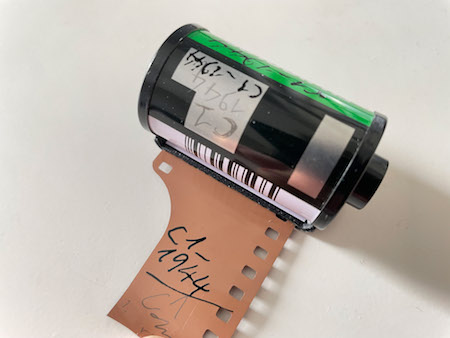
35mm film cassette and leader annotated with pencil and India ink. Photo copyright © 2024 by Tristan da Cunha.
• So Floyd’s introduction of the issue of film hardeners proves to be a red herring. Either vintage 1944 Kodak Super-XX film emulsion contained hardeners or it didn’t. If not, it’s certainly possible, even likely, that Capa’s films got hardened during processing. In any case, the films da Cunha processed — as close to Capa’s D-Day films as we could get, the same brand and type from the same period — didn’t melt off their acetate backing when subjected to high heat for prolonged periods after processing without added hardeners.
•
I should add that neither Mark Osterman nor the other expert on the subject of film hardeners cited by Floyd — Robert Shanebrook, “Worldwide Product-Line Manager for Eastman Kodak Professional Films for thirty-five years and author of the definitive book, Making KODAK Film” — should get held responsible for Floyd’s sly, deceptive elisions and misdirections in this inept effort to validate the “darkroom disaster” myth and rebut our dismantling thereof. Surely they had no say in the matter, and I suspect their appearance here as ostensible supporting witnesses for Floyd’s subterfuges and avoidances embarrasses them greatly.
No, Floyd alone is accountable for this. Having done his research, as he proclaims, he knows full well the following:
• The Mark Osterman microbrew film Floyd used for his own experiment — recently made from a 1925 non-Kodak formula — does not compare with the film Tristan da Cunha used in his experiments: Kodak Super-XX film from 1943 and 1944, the same film Capa used on Omaha Beach, from the same time period. This alone renders Floyd’s tests irrelevant.
• The fact that formulas for Kodak films of the period did not include hardeners has no significance, since hardeners in liquid and powder form (including a number of same manufactured by Kodak) were readily available and commonly used in the processing of film at the time.
• Given the frequent handling and use which the negatives of LIFE‘s photojournalists underwent, and their consequent vulnerability to damage, Capa’s films almost certainly got hardened during processing in LIFE‘s London darkroom.
• In any case, da Cunha did not add any hardener to the fixing bath when processing the Kodak Super-XX films he tested. Thus he conducted his heat tests on unhardened film, demonstrating that the emulsion of Kodak Super-XX film manufactured in 1943-44 does not melt when subjected to high heat for a prolonged period in a drying cabinet with a closed door.
•
Publishing easily disprovable material like Floyd’s — replete with claims that any experienced photographer or knowledgeable photo-historian immediately recognizes as spurious — without even rudimentary fact-checking does the reputation of the editorial staff of L’Oeil de la Photographie no service.
In the second part of this post I’ll take on Floyd’s attempt to justify the account offered by Robert Capa and John Morris, LIFE‘s London-based assistant picture editor, of the supposed “darkroom disaster” that “ruined” the majority of Capa’s D-Day negatives. …
(Part 1 I 2)
•
This post sponsored by a donation from photographer Mark Minard.
•

Special offer: If you want me to either continue pursuing a particular subject or give you a break and (for one post) write on a topic — my choice — other than the current main story, make a donation of $50 via the PayPal widget below, indicating your preference in a note accompanying your donation. I’ll credit you as that new post’s sponsor, and link to a website of your choosing.
And, as a bonus, I’ll send you a signed copy of my new book, poetic license / poetic justice — published under my full name, Allan Douglass Coleman, which I use for my creative writing.
[donateplus]


Thank you, Allan, for your response to the recent article that was published giving an overview of my work. You are correct, I did not include the details as that would have made the article too long, but these are explained in my forthcoming book. To quickly address your comments regarding Kodak Super-XX film, the samples that da Cunha tested were eight decades old. Over time, the collagen in a film emulsion will degrade by hydrolysis from ambient moisture and can naturally cause it to cross-link. Natural cross-linking occurs when the collagen polypeptides degrade into aldehydes, or when oxidation produces free radicals that drive ionic bonding of collagen molecules. The lay term for cross-linking is hardening – it prevents the emulsion from melting. This is why archivists recommend long-term storage of unexposed film in cool, dry environments. The results using antique film cannot be extrapolated to represent fresh film in 1944. One cannot assume that Wild or Bradshaw added hardeners while developing and it was not common practice to lend original negatives to outlets for reproduction. 8×10 glossy prints were made for that purpose. I appreciate your reply and true hope that your team and I can have a civil, objective discussion going forward since none of you have replied to the emails that I have sent you to discuss this. My purpose is not to venerate or vindicate Capa. Rather my goal is to address your accusations that three D-Day veterans independently lied to their families about their experience Omaha Beach early in the morning on D-Day. I don’t believe they did and that is what drove me to initially reach out to you, to do my own research when your team failed to respond to my emails, and to make my findings public. My findings are an alternate history to your alternate history. As one of your colleagues has said, it will be up to the reader to decide.
Feeding your rationale verbatim into ChatGPT yields the following:
The explanation you’re quoting mixes some real concepts from photographic emulsion chemistry with quite a speculative interpretation — and as stated, it is scientifically weak.
In a black-and-white film like Kodak Super-XX, the emulsion is not made of “collagen” in the strict sense, but of animal gelatin (proteins derived from collagen). This gelatin forms the matrix that holds the silver halide crystals.
What is broadly true in the idea:
Over time, a photographic emulsion can indeed change:
• gelatin can undergo degradation (hydrolysis, oxidation);
• it may become more brittle, or in some cases behave irregularly depending on storage conditions;
• cross-linking (reticulation) phenomena can occur, but mostly through external chemical agents (hardening fixers, formaldehyde, pollution), not simply “naturally” in a uniform or beneficial way.
And yes: archivists recommend cool, dry storage because gelatin is an unstable organic material.
What is problematic in the argument
The idea that an 80-year-old film could have “naturally hardened” to the point of withstanding extreme temperatures (such as 130 °C) is highly questionable:
• Natural aging of gelatin does not produce a uniform or controllable hardening comparable to a hardening fixer (chrome alum, formaldehyde, etc.).
• Chemical degradation tends to make the emulsion more fragile, not more resistant to extreme heat.
• The concept of “naturally protective cross-linking” is often invoked in such debates, but it is poorly supported as a mechanism capable of explaining massive thermal resistance.
Key point often overlooked
Even if the emulsion changes over time, in a film like Super-XX it is essential to distinguish between:
• the emulsion (gelatin + silver)
• the base (cellulose acetate)
And more importantly: at very high temperatures (above 100–120 °C), it is not only the gelatin at stake:
• the acetate base itself begins to deform, soften, or melt long before any “natural cross-linking” theory becomes relevant.
Simple conclusion
The argument you quoted is mainly used to retroactively justify an experimental result, but:
• it relies on a partial and speculative interpretation of chemistry;
• it overestimates the ability of natural aging to “strengthen” an emulsion;
• and it does not, by itself, explain resistance to temperatures approaching 130 °C.
_________________
Of course, an AI-generated response does not automatically merit a vote of confidence. Food for thought, nonetheless.
I should add that a hardening fixer is intended to harden the emulsion, making it more resistant to scratches. It is not used to “glue” the image to the film base. So the self-hardening you propose of the vintage Super-XX films would not explain their emulsions’ adherence to the acetate base.
Speaking of which, Tristan da Cunha notes, in an email to me dated June 7, “[M]odern film bases are not made from the same materials as those used in 1944. I don’t know exactly how Floyd’s film was manufactured, but the emulsion is almost certainly coated on a cellulose triacetate base (the standard material used for virtually all photographic films since 1951) or on polyester. Capa’s film, on the other hand, was on a cellulose diacetate base. That alone could account for the difference.”
You write, “One cannot assume that Wild or Bradshaw added hardeners while developing and it was not common practice to lend original negatives to outlets for reproduction. 8×10 glossy prints were made for that purpose.” First, by the same token one cannot assume that Wild or Bradshaw did not add hardeners while fixing the films, since that was a standard practice at the time.
Second, my statement that “photojournalists’ negatives … would get subjected to frequent use and handling under newsrooms’ deadline conditions, making them especially vulnerable to scratches, fingerprints, and other accidental damage” does not in any way suggest that periodicals “len[t] original negatives to outlets for reproduction.” It refers to in-house use of negatives to make prints for both in-house use and licensing of images for reproduction by other outlets. (I’ve added the words “in-house” to that sentence to prevent future misreadings.)
(Additionally, of course, in this specific situation, LIFE‘s D-Day negatives by Capa and Scherman faced immediate handling by the Ministry of Information censors, who sometimes actually drew on the negatives themselves with red ink to censor particular details. Which I would argue might warrant taking the extra step of hardening the negatives as a protective measure.)
I have not responded previously to your posts because (a) I distrust your motives and methods, (b) I find your efforts so seriously flawed that correcting them requires a great deal of work, and (c) you have in any case taken them offline, save for the one in question, so that any response from me would have no accessible reference points.
With respect, students of darkroom processes in the 1970s widely understood that “archivists recommend long-term storage of unexposed film in cool, dry environments” to prevent ‘fogging’ (the low level exposure of the film’s emulsion caused by ambient heat) – not to prevent ‘spontaneous hardening’.
Thank you Allan. I lay out my argument in greater detail in my forthcoming book. I’m glad you’re engaging with me. Hopefully, between the two of us we’ll be able to get a better idea of Capa’s D-Day and his photos. By the way, AI platforms tend to “hallucinate.” It’s better to do the research yourself. And the gelatin in photographic emulsions is ground up cow bones which are mostly collagen, which is a glycoprotein with ionic groups that are susceptible to oxidation by free radicals.
All these painfully obvious efforts to blind us with science can’t disguise the simple fact that no proof exists to support the tacit claim that Capa’s films didn’t get hardened during processing in LIFE‘s London darkroom on the night of June 7, 1944. Kodak offered half a dozen hardening options at the time, as discussed above. Hardening by using either a separate hardener solution or a hardener mixed into the fixing bath was a standard practice at the time.
There are several reasons that photographic film should be stored in a cool, dry environment.
Of course there are. We don’t know how the vintage 1943-44 films da Cunha tested were stored, of course. But he details his tests of their viability, and exposure/processing adjustments for their age, in his report, available here:
https://tdacunha.com/wp-content/uploads/2022/01/Robert-Capa-and-the-mystery-of-the-lost-photos-2.pdf
You are correct that a hardener when added to an emulsion, either in manufacture or later in developing solutions, prevents scratching but it does this through cross-linking of the polypeptides and glycoproteins. This stabilizes the emulsion by forming a lattice of protein molecules, rather than individual polypeptides. The same mechanism which minimizes scratching also prevents melting, which is the separation of independent molecules from each other. So it’s the same mechanism. It’s why you can squeegee a modern film.
Continued quoting of extracts from a handbook on photo chemistry does not hide the failure to justify the claim that the emulsions on Capa’s films melted because they had been processed without hardener.
Verifying that claim would require either (a) production of a copy of the printed darkroom protocols for LIFE‘s London lab circa 1944 (if available) or (b) first-person testimony from someone who worked in the darkroom at the time. The article in question, and the comments appended here by its author, provide neither.
Absent hard evidence, the claim is mere speculation. For that speculation to appear more than groundless requires, at a bare minimum, a clearly articulated rationale for why LIFE‘s London lab circa 1944 would not have used a hardening solution as a matter of course. Failure to provide such a rationale marks the claim as baseless and therefore frivolous.
You make a lot of assumptions, Allan. I’m not quoting extracts from a handbook on photo chemistry. You may not realize that physicians must take a significant amount of coursework in organic chemistry and biochemistry and as an orthopedic surgeon I am particularly versed in the organic chemistry of bone proteins, ie collagen, which is the primary component of film emulsions.
You are correct, I do not have any objective evidence that the techs did not add hardeners that night, but you have no proof that they did. You assume that they did and expect that will be taken as truth. Can you at least admit that neither of us knows what happened? We both are trying to figure it out. I see no reason to be uncivil.