 On January 25, 2025 a feature-length documentary film titled premiered at the Sundance Film Festival in Park City, Utah. Produced by the VII Foundation, a photojournalism-centered nonprofit based in Arles, France, the film argues that an iconic Vietnam War photograph has been deliberately misattributed for decades. The Vietnamese emigré the film claims as that photo’s author was in attendance at the premiere screening.
According to the Associated Press (AP), Vietnamese staff photographer “Nick” made this photograph, officially titled “The Terror of War” and widely referred to as “Napalm Girl,” on June 8, 1972. The image subsequently won the 1974 Pulitzer Prize for photojournalism and the “Picture of the Year” award from World Press Photo (henceforth WPP). It shows Phan Thi Kim Phuc, then 9 years old and naked, and several other terrified children running past members of the press corps down a highway outside the village of Trang Bang, not far from Saigon, in the immediate aftermath of a bombing attack.
 The Stringer claims that a local Vietnamese freelance photographer, or “stringer,” Nguyen Thanh Nghe, actually made that world-famous photograph, selling its negative outright that same day to AP for USD $20. It also claims that, after acquiring the negative and rights, AP’s Saigon bureau chief, the late photojournalist Horst Faas, ordered staffer Carl Robinson to falsify the attribution by crediting it to Ut. (It turns out that Nghe was not a random onlooker but, instead, a professional cinematographer and photographer, educated first in a film & photo school in Saigon and then in a U.S. Army Signal Corps program at Ft. Monmouth, NJ.)
The film documents the identification of Nghe and the process of tracking him down in Vietnam for interviews about the making of “Napalm Girl” and the aftermath thereof. It also includes interviews with others connected to the moment of the image’s creation and the initial distribution thereof by the Associated Press, plus forensic evidence in the form of a digital 3D-modeling reconstruction of the situation on the road at that location on that day, based on the available still photos and videos of the scene, created by INDEX, a Paris-based non-profit forensic investigation group.
Overall, in sum, The Stringer proposes that (a) AP Saigon bureau chief Horst Faas falsified the initial attribution of “Napalm Girl,” (b) Nick Ut not only knows he didn’t make that photo but has lied about it for career purposes ever since, and (c) Ut has also lied about giving Kim Phuc water from his canteen and then taking the initiative of transporting her to the hospital shortly after making that exposure, out of humanitarian concern for her well-being.
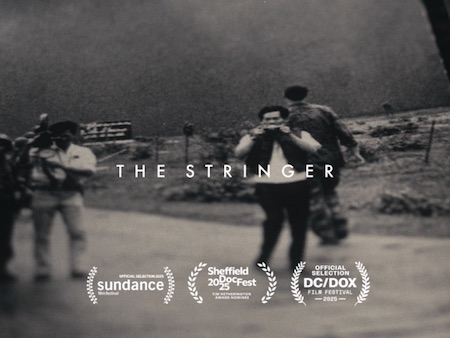
VII Foundation, The Stringer (2025), trailer promo, screenshot
•
Predictably, the film sparked a firestorm, reaching far beyond photojournalism circles and making headlines worldwide. Many of those who responded publicly to the film early on did so without actually seeing any of it beyond the brief clips in its published trailer). While The Stringer had subsequent public screenings at several film festivals, and its producers made it available for several invitation-only password-protected online viewings on Vimeo, it had yet to achieve general release. Its producers were looking for their best distribution offer(s) for both theatrical release and online streaming, while (b) entering it in various film festivals, as part of a broader campaign to (c) generate as much publicity around it as possible, so as to (d) make it as enticing as possible to distribution candidates. That’s standard procedure for an independent documentary film.
Eventually, in September 2025, the VII Foundation closed a deal with Netflix, where you can see the film for yourself. You can also find it, I’m told, at bootleg sites such as MovieLair and BingeWatch, though as a matter of policy I don’t endorse violating copyright in that way.
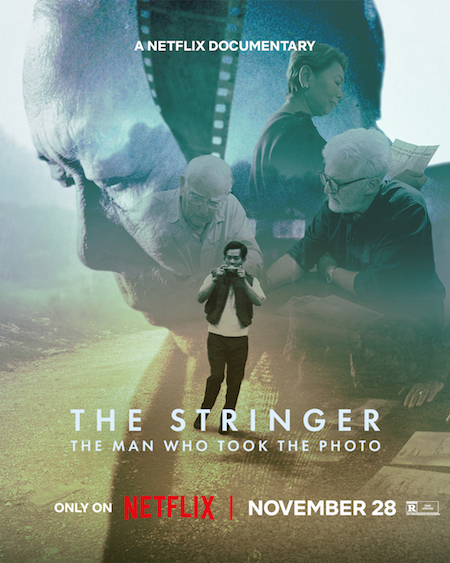
VII Foundation, The Stringer (2025), release promo, screenshot
•
 Since the general public, and even the much smaller but still significant audience comprised of individuals with a serious and even professional interest in the subject, could not immediately access the film, the debate over it at the beginning necessarily took place in a vacuum — albeit one that AP and WPP strove to fill. To their credit, since The Stringer challenges the credibility of both AP and WPP, the two organizations initiated substantial independent investigations of the claims made in The Stringer.
AP has now published three versions of its report:
- The original, based on its own photo archives, relevant internal documents, and other available still and video footage (January 15, 2025). Produced prior to AP access to The Stringer. Click here for a pdf download.
- An updated version (May 6, 2025), produced after AP had access to The Stringer. Click here for a pdf download.
- An online version of that report, including videos and a digital video reconstruction of the scene. Click here to view this online.
The upshot: “Following a nearly year-long investigation, the AP has concluded that there is not the ‘definitive evidence’ required by AP’s standards to change the credit of the 53-year-old photograph.”
 World Press photo began its response by publishing an open letter, “About the making of the 1973 World Press Photo of the Year: Reflections from executive director Joumana El Zein Khoury,” at its website on March 1, 2025. Shortly thereafter, on May 16, WPP issued a “summary of investigative analysis.” Its title, “World Press Photo is suspending authorship attribution of the iconic 1972 photograph known as “The Terror of War,'” reveals its conclusions. (Click here for a pdf download.) Realizing that this was insufficient, a month later, on June 26, 2025, they released the full document: “World Press Photo’s Investigation into Authorship Attribution: Conclusion by World Press Photo and Full Investigative Report.” (Click here for a pdf download.)
The eventual final theatrical-release version of The Stringer incorporates responses to both the AP and WPP investigations, including additions to the INDEX 3D reconstruction based on newly available images from the AP report. It ends with Nghe and his daughter in their southern California home, watching a video of Joumana El Zein Khoury publicly explaining WPP’s unprecedented decision to suspend attribution of “Napalm Girl” to Nick Ut.
•
Not surprisingly, in early March of 2026 Nick Ut filed a criminal defamation lawsuit in France against Netflix and the VII Foundation over the claims made in The Stringer. On May 15 the French court held what’s called a “consignation hearing,” at which, according to one of this blog’s correspondents,
Ut must pay a certain sum of money to the court (the amount is set by the judge based on his income, typically around €1,000). This is meant to prevent just anyone from suing anyone else for defamation over anything. It helps avoid abuse and shows that the allegation of defamation is sincere and serious. This sum will be returned to Nick Ut once the case is over. If it turns out that his claim has no basis, the judge may order that it be forfeited.
The actual trial will take place almost a year from now: March 16, 2027
•
So that’s where things stand. The controversy has died down. Safe to say that anyone inclined to pick a side has already done so, whether steeped in the evidentiary material (film plus AP report plus WPP report), cursorily aware of it, oblivious to it, or anywhere else along that spectrum.
Safe also to say that many of this blog’s readers followed this uproar as it developed, familiarized themselves with the materials and the debate to some extent, and don’t need another recap beyond the above. If you want more, an online search involving the terms “associated press napalm girl stringer” will bring up a year’s worth of reading.
I’ve tracked the uproar over this film since it first became news. Watching all this unfold has evoked a number of ruminations — not just on that photo, the film, and the charges involved but on the forensic investigation of photographs as a project. So I’m gathering and refining them in these posts. …
•
This post sponsored by a donation from Carlyle T.
•
Special offer: If you want me to either continue pursuing a particular subject or give you a break and (for one post) write on a topic — my choice — other than the current main story, make a donation of $50 via the PayPal widget below, indicating your preference in a note accompanying your donation. I’ll credit you as that new post’s sponsor, and link to a website of your choosing.
And, as a bonus, I’ll send you a signed copy of my new book, poetic license / poetic justice — published under my full name, Allan Douglass Coleman, which I use for my creative writing.

Leave a Reply