
[Beuford Smith (April 12, 1936 – June 7, 2025) died of cancer in Brooklyn. For his New York Times obituary, click here.
In addition to pursuing his own work as a freelance and starting his own picture agency, Cesaire, Smith was a founding member of the Kamoinge Workshop, invited into it by Roy DeCarava, and served as a founding editor of the The Black Photographers Annual, which appeared in four hardcover volumes between 1973 and 1980. The Virginia Museum of Fine Arts in Richmond, VA holds Smith’s archives. No book-length collection of his work appeared in his lifetime, which surprised and saddened me. Perhaps some publisher will rectify that grievous oversight posthumously.
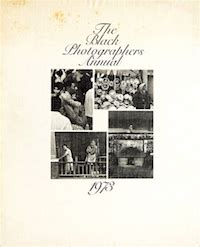
Black Photographers Annual (1973), cover
Beuford and I both participated (separately) in the interviews filmed for “Conversations with Roy DeCarava,” the 1983 documentary short about the life and work of Roy DeCarava by Carroll Parrott Blue. We exchanged occasional emails, and crossed paths periodically, most recently at a 2018 event celebrating the facsimile reprint edition of DeCarava’s Sweet Flypaper of Life.
The following essay, a review of his 1972 solo exhibition “Time” at the Studio Museum in Harlem, first appeared in the New York Times on July 2, 1972, under the headline “He Records the Texture of Black Life.” I included it in my 1979 collection of essays, Light Readings: A Photography Critic’s Writings, 1968-78. — A.D.C.]
•
Beuford Smith: “He Records the Texture of Black Life”
For all intents and purposes, the tradition of black photography begins with Roy DeCarava. DeCarava is not the first black photographer (though he was the first one to be awarded a Guggenheim); the history of black photography stretches back more than a century. Nor is he the best-known; Gordon Parks is closer to a household word than DeCarava, and even James Van DerZee — rediscovered recently during the making of the Met’s “Harlem On My Mind” — has received more public attention.
DeCarava has never had a one-man show at any major museum (his largest exhibit to date, a solo retrospective which was hardly a swan song, having been presented by the Studio Museum in Harlem several years ago). And, considering the extent and importance of the remarkable body of work he has created over the last three decades, he has been vastly underpublished; only one slim volume of his images, The Sweet Flypaper of Life (with text by Langston Hughes), has ever been issued, and that one is almost 20 years old, though miraculously still in print.

Beuford Smith, Two-Bass Hit (1972)
•
Despite that, DeCarava’s influence, as another black photographer has stated, “extends throughout the field.” There are few black photographers today who have not been affected by DeCarava, whether they know it or not. To some he has served primarily as a symbol of intransigent honesty; to others he has been a mentor, either directly or second-hand, through his organization of the still-active Kamoinge Workshop, a black photographers’ workshop. And the impact of The Sweet Flypaper of Life can be felt, attitudinally and conceptually, in the work of almost all black photographers, so that virtually every show by a young black photographer is a form of homage to DeCarava.
Beuford Smith makes his debt to DeCarava explicit in the biographical data accompanying his current show at the Studio Museum, indicating therein that it was The Sweet Flypaper of Life which made him turn to photography in the first place. The show itself — “Time,” a selection of over 60 of Smith’s black-and-white prints — reveals that Smith has absorbed DeCarava’s influence without becoming enslaved by it, and has evolved a distinctive and charged vision which is based on the black experience, but extends far beyond it.
The similarities between Smith and his mentor are readily seen. There is the same adherence to a head-on, gimmick-free documentary style, a concentration on urban black life as the central theme, and a consistent confrontation of human emotion. There is also a resemblance in their printing which strikes me as noteworthy, though I do not yet know how to interpret it, nor even how to say it without it sounding peculiar as hell. Most black photographers whose work I’ve seen — DeCarava, Smith and Fundi, in particular — evince not only a fearlessness of, but a love for, deep, rich black (and lots of it) in their prints. I am not speaking of dark prints as opposed to light ones, but absolute black as a tonal equivalent of space and an emotional metaphor for the void. There are some white photographers — W. Eugene Smith being a prime example — who use black similarly, but they seem to be proportionately fewer; many white photographers tend to turn skittish at the sight (or even the thought) of what one once referred to as “large masses of undifferentiated black.” I have no explanation for this phenomenon, but I think it merits some consideration. Smith’s “Sliding Board” is just one of many instances in this show.

Beuford Smith, Man with Roses (1972)
While one can find traces of DeCarava in various aspects of Beuford Smith’s work — the poignancy of “Man with Roses,” for instance, is worthy of DeCarava though wholly Smith’s own — the differences are significant. Though, like DeCarava, he records the texture of black life (in such pictures as “Cadillac” and “Garment Worker”), as well as the music which is woven into it, his exuberance — witness “Woman Bathing,” a rooftop nude — is more overt and his anger more explicit.
Through Smith’s eyes we are forced into an awareness of the constant indignity of racist graffiti, whether directed at blacks, as in “No Niggers,” or at Puerto Ricans, as in the tragic triptych “Ruben moved.” The increasingly ugly symbolism of the American flag — whether decaled to a police-car windshield, held by a too-young white child at a parade, or toted by a particularly vicious-looking man — is explored in images which have specific political implications but remain unpolemical by virtue of their pity. And the anger contained within the two-panel series of images made the day after Martin Luther King’s assassination is tempered, but not muted, with sorrow.
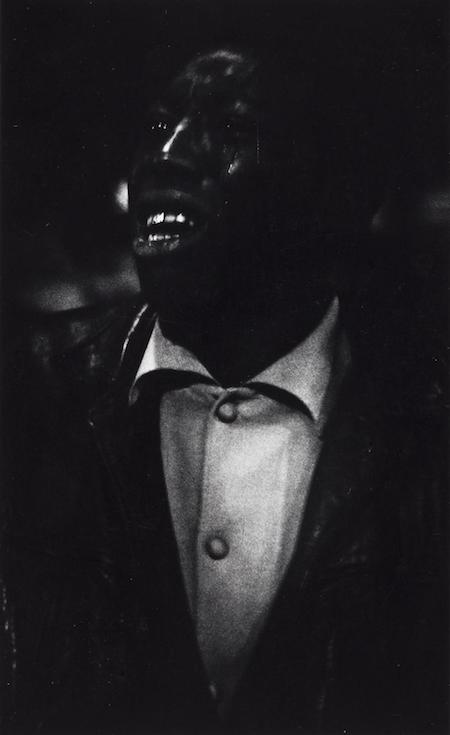
Beuford Smith, Man Crying/Martin Luther King, Jr. (1968)
Smith also demonstrates, in this exhibit, an unusually deep concern with old age, which runs as a sub-theme throughout. The photographer attributes this partly to the experience of being raised by his grandmother and partly to his feeling that “old women are the mothers of us all. You see lots of pictures of young black women with their Afros,” he adds, “but not so many of the women who brought them up.” Whatever their source, these images — “Old Woman in Window” with its mourning wreath like the seal of death; “Hop Scotch,” with its hint of a tombstone; “Canes,” “Old Woman with Crutch,” the tender “Saturday,” the pathetic “Woman Carrying Doll,” and many others — speak with a precocious empathy of some of the horrors of age and isolation. That a number of the remaining images deal directly with death thus comes as no surprise, and Smith’s rage against the reaper makes itself felt in “Coat,” “Doll #5,” and the purgatorial “Rope,” as well as in the torn posters of “Death Mask.”
It seems paradoxical to say that gentleness and joy are also contained in Smith’s work, even at its fiercest, but the truth of that is perhaps his greatest accomplishment and the firmest possible foundation for the major body of work he has just begun — and, indeed, can at this stage hardly avoid — creating.
•
This post sponsored by a donation from Carlyle T.
•
Special offer: If you want me to either continue pursuing a particular subject or give you a break and (for one post) write on a topic — my choice — other than the current main story, make a donation of $50 via the PayPal widget below, indicating your preference in a note accompanying your donation. I’ll credit you as that new post’s sponsor, and link to a website of your choosing.
And, as a bonus, I’ll send you a signed copy of my new book, poetic license / poetic justice — published under my full name, Allan Douglass Coleman, which I use for my creative writing.
[donateplus]

Leave a Reply